
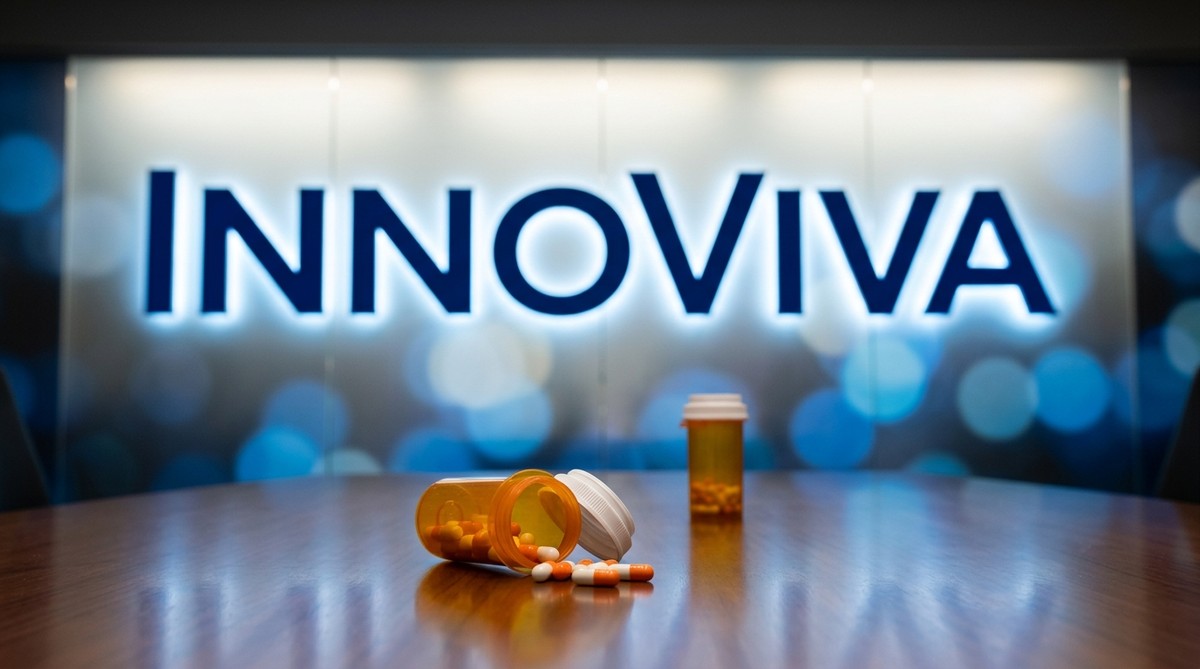
Innoviva spent most of its life as a toll booth on two GSK inhalers. Every time a patient filled a BREO or ANORO prescription, Innoviva collected a royalty check and did almost nothing else. That was the whole model, and for a while it was a very good one. Then the checks started getting smaller, and the company had to decide what it wanted to be next.
The latest 10-Q, filed August 5, 2026 for the quarter ended June 30, covers a business that is genuinely mid-transition: royalty revenue still pays most of the bills, but a specialty drug business is growing fast enough to matter. The tension between those two lines is the story right now.
The gist of it
The filed numbers show royalty income drifting lower while a newer specialty drug unit grows at roughly a quarter more revenue each year. The stock sits just below its own decade median valuation multiple, according to our data. The open question is whether the specialty business grows fast enough to replace what the royalties are quietly giving back.
Two numbers that should not coexist
Here is the uncomfortable pairing inside the Q2 2026 filing: the company held more cash than a full year of total revenue at quarter-end, while simultaneously reporting a large net loss for the quarter. The loss was not an operating collapse. It came almost entirely from mark-to-market swings in the value of equity investments Innoviva holds, the kind of paper loss that reverses when markets move the other way. The cash pile, by contrast, is real and sitting there.
That distinction matters because it separates what the business earned from what the accounting statement shows. The operating engine kept running; the investment portfolio had a bad quarter on paper.
What the royalty line is actually doing
Royalty revenue, the old core of the company, came in at roughly $60 million for Q2 2026. That sounds stable in isolation. Zoom out and the picture is less comfortable: net royalty revenue fell meaningfully between fiscal 2022 and fiscal 2025, per the 2025 annual report. Some of that drop reflects the 2022 sale of Trelegy royalty rights, which was a deliberate choice. But Seeking Alpha’s Fair Value Desk, writing in August 2026, described RELVAR/BREO as “mature products with declining sales” and said GSK royalties are “now under pressure.” The filed trend agrees with that read.
Generic competition for complex inhalers is harder to execute than for a simple pill, which is why the erosion has been slow rather than sudden. But slow erosion is still erosion, and the royalty line has no obvious catalyst to reverse it.
What is actually growing
Innoviva Specialty Therapeutics, the unit built by folding in Entasis and La Jolla Pharmaceutical in May 2023, posted U.S. net product sales of $36.6 million in Q2 2026, up 26% from the same quarter a year earlier, per the filed 10-Q. That is the kind of growth rate that changes a company’s center of gravity over several years, not quarters.
The pipeline behind that number includes ZEVTERA and XACDURO, both FDA-approved antibiotics, plus NUZOLVENCE, approved in December 2025 for a type of gonorrhea that standard drugs can no longer reliably treat. The company is presenting clinical data for ZEVTERA and NUZOLVENCE at IDWeek 2026 this week, October 21 through 24, which is the main U.S. infectious-disease conference. A new licensing deal with Dr. Reddy’s Laboratories takes XACDURO into emerging markets, and a new subsidiary called Nortiva Bio is targeting extended-release oral drug delivery. The company is building surface area fast.
The specialty unit’s growth rate is the metric that will most directly determine whether the transition thesis holds over the next several quarters.
The debt and cash picture
Total debt stands at roughly $331 million, per Stock Analysis data through mid-September 2026. Against free cash flow over the last twelve months, that is a debt load the business could theoretically retire in well under two years of cash generation. Interest paid was modest in the first half of 2026, so the debt is not eating the business alive. One small amendment worth noting: Innoviva extended a convertible loan to Armata Pharmaceuticals to June 2027, per an OTC Markets filing from January 2026, a reminder that the investment portfolio carries its own moving parts.
Where the analysts disagree
The analyst picture is unusually split. Oppenheimer’s Les Sulewski initiated coverage in September 2026 with a positive outlook and a $35 target, per MarketBeat. Goldman Sachs’s Asad Haider held a cautious view with an $18 target as of May 2026. Those targets reflect sharply different assumptions about royalty decay and specialty growth rates; readers can weigh which set of assumptions the filed data better supports.
Reading the numbers
- Q2 2026 total revenue: $119.6 million. What it is: the sum of royalties, product sales, and licensing fees for one quarter. What it means here: revenue is running at a pace that would put the full year near the high end of recent history. Everyday version: if a household earned $119,600 in a single quarter, the annual run rate would be nearly $480,000, well above the $411,000 it earned last year.
- IST U.S. net product sales growth: 26% year over year. What it is: how much faster the specialty drug unit sold products in Q2 2026 versus Q2 2025. What it means here: at that pace, the specialty unit roughly doubles in size every three years. Everyday version: a business doing $100 of sales that grows 26% a year sells $126 next year and $159 the year after.
- Net loss of $83.4 million for Q2 2026. What it is: the bottom-line accounting result after marking investment holdings to market prices. What it means here: this figure is almost entirely a paper loss from investment value swings, not a sign the operating business is losing money. Everyday version: a household whose stock portfolio fell $80,000 on paper in one quarter looks broke on a balance sheet but still cashed their paychecks.
- Cash of $570 million at June 30, 2026. What it is: actual money in the bank. What it means here: the company holds more cash than a full year of revenue, giving it room to fund the specialty buildout without needing outside money. Everyday version: a family earning $100,000 a year that has $140,000 in savings can take risks a family with $5,000 cannot.
- P/E of 6.3 versus a decade median of 6.8, per our data. What it is: the price-to-earnings multiple compared to its own historical average. What it means here: IF the specialty unit sustains its current growth trajectory and royalty revenue stabilizes near recent levels, the same decade-median multiple of 6.8 would imply a modestly higher price; IF royalty erosion accelerates and specialty growth slows, the current discount could persist or deepen. The gap between those two scenarios is what the analyst disagreement documented above reflects.
Sources
- 10-Q for quarter ended June 30, 2026 (SEC EDGAR)
- 10-K for fiscal year ended December 31, 2025 (SEC EDGAR)
- Fair Value Desk, Seeking Alpha, August 6, 2026
- MarketBeat: INVA earnings and analyst ratings
- Stock Analysis: INVA statistics
- OTC Markets: Armata loan amendment filing, January 2026
- StockTitan: Innoviva 8-K, Q2 2026 results