
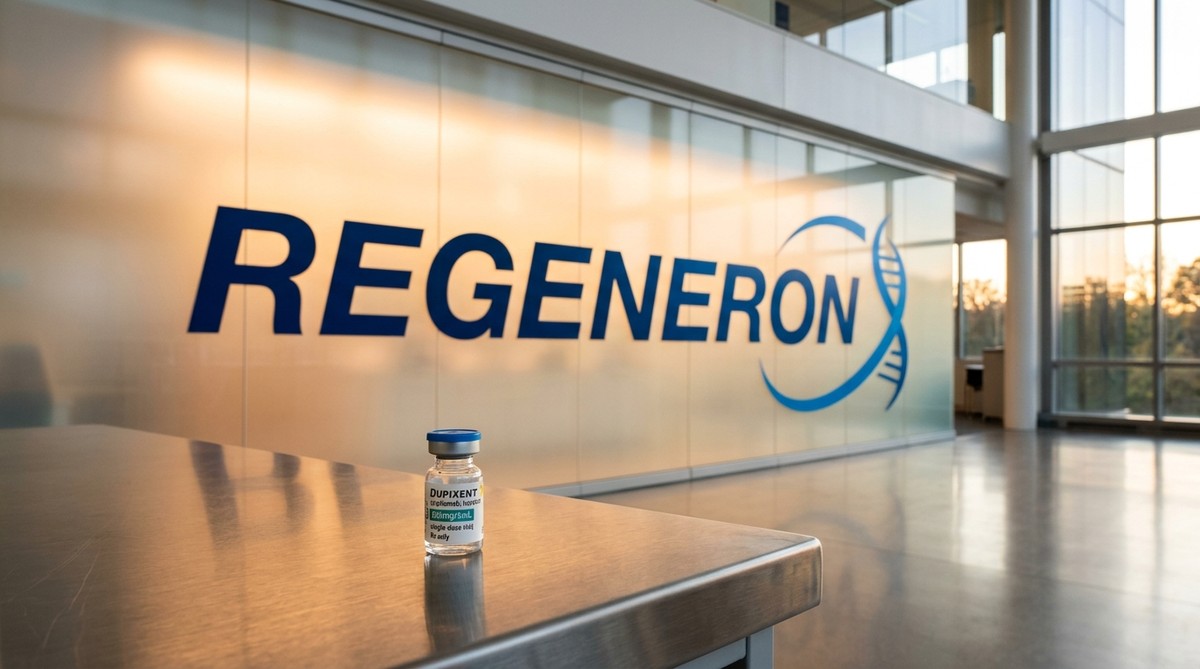
Regeneron spent most of the 2010s as a one-drug story, riding EYLEA’s dominance in eye disease to a valuation that made Wall Street nervous. Then Dupixent arrived, and the company became something rarer: a platform that actually worked twice. By 2021, that combination pushed net margins above fifty percent, a level most pharmaceutical companies never touch. What followed was a painful correction, as COVID-era antibody revenue evaporated and margins fell back to earth. The question now, reading the 10-Q filed July 30, 2026, is whether the next chapter is already being written in the pipeline, or whether the market is paying for a story that stalls.
Before anything else
The filed numbers show a business whose full-year revenue grew at a near-standstill in 2025, while its flagship drug, Dupixent, grew global sales 38 percent to $6.0 billion in the second quarter. Those two facts cannot coexist forever: either Dupixent’s momentum pulls the whole company higher, or something else is dragging. The stock trades at a price-to-earnings multiple, meaning the price per dollar of annual profit, that sits just above its own decade median, so the market is paying close to a historically normal price for a company at an unusual inflection point. The open question is whether three late-stage regulatory decisions arriving before year-end resolve that tension upward or not.
The year’s arc: one number hiding another
Full-year 2025 revenue of $14.3 billion, reported in the 10-K filed January 2026, grew just over one percent over 2024. That headline is almost deliberately misleading. EYLEA, the original eye-disease injection that built Regeneron’s balance sheet, is losing ground to its own successor: EYLEA HD, a higher-dose version approved in 2023, which now accounts for the clear majority of the combined franchise’s U.S. sales, up sharply from just one quarter earlier. The old product is cannibalizing itself on purpose, and the transition creates a revenue air pocket that makes the top line look sleepier than the underlying business.
Zoom into the second quarter of 2026 and the picture sharpens. Total revenue reached $4.29 billion, up 17% from the same quarter a year earlier. Dupixent, the allergy-and-inflammation drug co-commercialized with Sanofi, recorded global net sales of $6.0 billion for the quarter alone. To understand what Regeneron actually is now: it is, more than anything else, a Dupixent royalty machine with a large research operation attached.
That research operation is not cheap. Full-year 2025 R&D spending reached $5.85 billion, a double-digit jump from 2024, and the company projects it will rise again in 2026 to a GAAP range of $6.45 billion to $6.68 billion. To put that in proportion: Regeneron is spending roughly every dollar it earns in a year on research, then earning its profit on top of that through drug sales. The bet is that the pipeline justifies the bill.
What compounds changed, and what failed
Three regulatory events between April and August 2026 tell the story of a company broadening deliberately. In April, Otarmeni received accelerated FDA approval as the first neurosensory gene therapy, approved for genetic hearing loss, a disease area Regeneron did not compete in five years ago. In August, Pasatru won approval for fibrodysplasia ossificans progressiva, a rare condition where soft tissue slowly turns to bone, affecting perhaps a few thousand patients in the U.S. Neither drug moves the revenue needle immediately, but both demonstrate that the antibody-discovery engine can produce approved medicines outside immunology and eye disease.
Then there is the failure. In May 2026, a Phase 3 trial testing fianlimab combined with Libtayo, Regeneron’s cancer immunotherapy, missed its primary goal in first-line metastatic melanoma. BMO Capital revised its valuation estimate downward in response, according to MarketBeat reporting on the event. The company also quietly discontinued a Phase 2 program in beta thalassemia as of late July 2026. Pipeline exits are normal; the melanoma miss stings more because Libtayo was supposed to be Regeneron’s answer to the massive oncology market that Dupixent does not touch.
The next few months carry real weight. The FDA has a November 2026 decision date for cemdisiran in myasthenia gravis, a nerve-muscle disease, after accepting the submission with Priority Review in June. A fourth-quarter readout is also expected for the combination of pozelimab and cemdisiran in paroxysmal nocturnal hemoglobinuria, a rare blood disorder. Two decisions in the same quarter represent a meaningful concentration of binary catalysts; the filed fundamentals would read differently under approval versus rejection scenarios for each.
The balance sheet shift worth knowing
One structural change from the filings deserves attention even though it generates no headline. By mid-2026, Regeneron fully repaid a $3.1 billion development balance owed to Sanofi, its longtime partner on Dupixent. That repayment means collaboration revenue flowing from Sanofi steps up starting in the third quarter of 2026. Think of it as a mortgage that just cleared: the house was always worth the same, but now more of the monthly payment stays in the account. Management flagged this at the Q2 2026 earnings call as a meaningful driver of second-half results.
The math and the mood
“The math” is what the filed fundamentals justify; “the mood” is what the market is currently paying. Our data puts Regeneron’s current price-to-earnings multiple at 16.5, just above its own decade median of 15.9, placing it at roughly the 60th percentile of its own valuation history. The mood is not euphoric, but it is not cheap either. The math says a business with margins above thirty percent, a drug growing 38 percent a year, and a structural revenue boost arriving this quarter is not obviously overpriced at that multiple. What the math cannot say is whether the melanoma setback signals a broader oncology problem, or whether November’s cemdisiran decision opens a new revenue line. Those are the witnesses still waiting to testify.
Reading the numbers
- $4.29 billion, Q2 2026 total revenue, up 17%. This is what Regeneron billed in a single quarter across all its drugs and partnerships. Seventeen percent growth in one quarter, for a company this size, means the underlying business is accelerating even as the annual headline looked flat. A household budget growing 17% in three months would feel like a raise and a bonus arriving together.
- $6.0 billion, Dupixent global net sales, Q2 2026, up 38%. Dupixent is an injection that treats conditions where the immune system overreacts: eczema, asthma, nasal polyps, now allergic fungal sinus disease. Thirty-eight percent growth means roughly $1.65 billion more in sales than the same quarter last year. For context, that incremental gain alone is larger than many mid-size pharmaceutical companies’ total annual revenue.
- $5.85 billion, full-year 2025 R&D spending. Research and development spending is the cost of building tomorrow’s drugs. At $5.85 billion, Regeneron spent more on research last year than it earned in net income, meaning the profit the company reports is generated on top of an enormous ongoing scientific investment. A family spending proportionally would be putting more into education and training than it takes home after taxes.
- 16.5, current price-to-earnings multiple, versus a decade median of 15.9. A price-to-earnings multiple is the price tag per dollar of annual profit. At 16.5, the market is paying $16.50 for every $1 Regeneron earns. Its own historical median is $15.90. The gap is small, which means the stock is priced close to normal for itself, neither a bargain nor a stretch by its own history.
Sources
- 10-Q for quarter ended June 30, 2026 (SEC EDGAR)
- 10-K for fiscal year ended December 31, 2025 (SEC EDGAR)
- Regeneron Q2 2026 financial results (GlobeNewswire)
- Regeneron full-year 2025 financial results (GlobeNewswire)
- Regeneron Q2 2026 earnings call transcript (Motley Fool)
- FDA approves Pasatru for FOP (Stacks921)
- FDA approves garetosmab (Endpoints News)
- Regeneron at Wells Fargo Healthcare Conference, September 12, 2026 (MarketBeat)
- Regeneron cemdisiran and pipeline update, September 14, 2026 (MarketBeat)