
The stock is down more than half from its 52-week high. The company just raised its full-year revenue guidance. Both of those things are true at the same time, and that gap is the whole story.
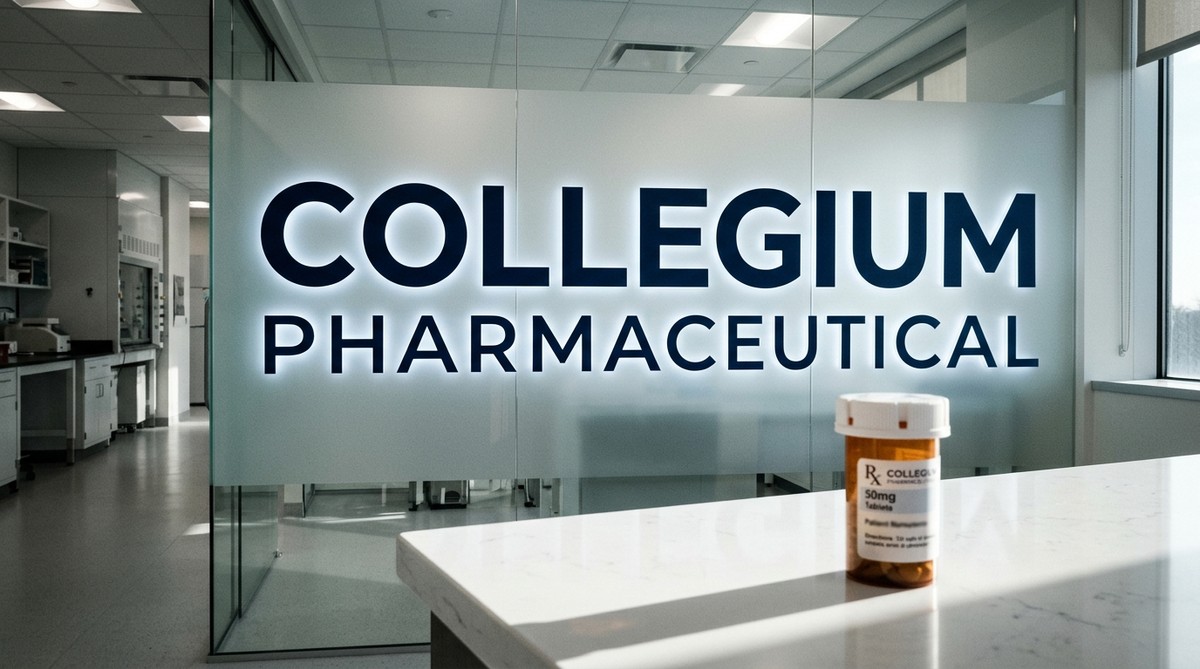
Collegium Pharmaceutical started life as a single-product pain company, built around an abuse-deterrent opioid called Xtampza ER that the FDA approved in April 2016. For years, the market treated it accordingly: a niche player in a legally fraught corner of medicine, priced like one. Then, in early 2020, Collegium paid $375 million for the Nucynta franchise, a deal management called “financially transformative,” and the revenue line proved them right. By early 2024 the company was buying into ADHD treatment with the acquisition of Jornay PM, and by May 2026 it closed a $650 million purchase of AZSTARYS, a second ADHD drug. The business that trades today is not the one from 2016. The market, for now, seems unconvinced.
The gist of it
The filed numbers show a business that has grown revenue every year since 2022 and is now guiding toward roughly $840 million for the full year 2026, a scale that dwarfs where it stood just four years ago. The stock, at $22.45, sits at a price-to-sales multiple (the price tag per dollar of annual revenue) at the very bottom of its own decade-long range, our data show. The open question is whether the market is correctly pricing a structural risk, or whether it is applying a pain-company discount to a business that has quietly become something else.
What the filings actually show
The 10-Q for the quarter ended June 30, 2026, filed August 6, shows net product revenues of $199.9 million for the quarter, a modest increase over the same period a year earlier. That is a business doing nearly $200 million in a single quarter, which is more than the entire company earned in all of fiscal 2020. Gross profit for the quarter came in at roughly 55 cents on every dollar of sales.
The ADHD side of the portfolio is doing the heavy lifting. Jornay PM revenue rose by more than two-fifths year-over-year to $46.1 million in Q2 2026, and the newly acquired AZSTARYS added a further contribution in its first partial quarter, according to the August 6 earnings release. Jornay PM now holds nearly three-tenths of the branded long-acting methylphenidate market, up meaningfully in a year, per the same release.
The pain portfolio is a more complicated picture. Belbuca, an opioid film for chronic pain, grew at a healthy clip. But Xtampza ER and the Nucynta franchise both fell, hurt by authorized generics that carry lower net prices. The company launched authorized generics of Nucynta ER itself in early 2026, essentially competing with its own branded product to capture some of the generic market before third parties do. It is a rational defensive move, but it compresses the revenue line in the near term.
The GAAP net loss for Q2 2026 was $15.1 million, which sounds alarming until you see that the majority of operating expenses in the quarter were non-cash amortization of acquired intangibles, the accounting charge that spreads the cost of an acquisition across many years. The $650 million paid for AZSTARYS will generate that kind of charge for years to come. On an adjusted basis, the business is generating substantial cash; the company guided for roughly $455 million at the midpoint in adjusted EBITDA (earnings before interest, taxes, depreciation, and amortization, a rough proxy for operating cash generation) for the full year, per the Q2 2026 earnings call transcript. Cash on hand stood at $129.5 million as of June 30, down sharply from year-end 2025, reflecting the AZSTARYS acquisition cost.
Readers parsing the filings will find that the business is generating real cash, the GAAP loss is mostly an accounting artifact of acquisition accounting, and the debt load from two large acquisitions is the genuine financial risk the numbers surface.
Where the multiple sits in its own history
Here is the contrast that the lens of this piece is built around. Our data show that Collegium’s price-to-sales multiple, the amount the market pays per dollar of annual revenue, currently sits at 3.7. The median for this stock over the past decade is 7.6. Today’s reading is at the zero percentile of its own history, meaning it has never been cheaper relative to its revenue than it is right now.
The price-to-earnings multiple tells a similar story from a different angle. At roughly the eighteenth percentile of its own decade, our data show that about four out of every five historical observations found the market willing to pay more per dollar of profit than it is today.
The math and the mood, to use our framework, are currently divergent, a divergence that could reflect a genuine structural risk the filings have not yet resolved, or a valuation gap, or both; the data do not adjudicate between those readings. The math, drawn from the filed revenue trajectory and the company’s own guidance, describes a business that has roughly quadrupled in scale since 2020 and is still growing. The mood, what the market is currently paying, reflects something closer to a distressed opioid company with uncertain prospects. Those two readings reflect genuinely different assumptions about the business’s trajectory; which assumption the evidence ultimately supports depends on how the pain-portfolio decline and ADHD growth resolve over coming quarters.
Analysts at Oppenheimer initiated coverage on September 23, 2026, with an outperform rating and an implied valuation of $50. Truist Financial issued a positive rating with a similarly elevated implied valuation in early September 2026, per MarketBeat. Both ratings reflect a view that the current multiple understates the business’s scale; the data can confirm the gap exists but cannot confirm which reading of it is correct. The data cannot confirm or deny that; what it can confirm is that the gap between where the stock trades and where those analysts sit is unusually large.
The honest uncertainty here is whether the pain portfolio’s decline is a managed transition or an accelerating erosion. If Nucynta and Xtampza ER continue to shrink faster than ADHD grows, the revenue story changes. The filings do not answer that question yet.
Reading the numbers
- $199.9 million, Q2 2026 net product revenues (10-Q, June 30, 2026). What it is: total sales of all products in the quarter. What it means here: the quarterly run rate implies an annualized business of roughly $800 million, consistent with full-year guidance. In everyday terms: a business earning $200 million in a single quarter is doing more in three months than most mid-sized companies do in a year.
- 55% gross margin, Q2 2026 (10-Q, June 30, 2026). What it is: of every dollar of product sold, 55 cents remained after the direct cost of making and delivering it. What it means here: pharmaceutical businesses with durable branded products typically run margins in this range; it signals pricing power. In everyday terms: a bakery selling a $10 loaf and spending $4.50 on ingredients and baking keeps $5.50, which is roughly what this margin looks like at the product level.
- P/S of 3.7, at the zero percentile of its own decade (our data). What it is: the price-to-sales ratio is the total market value of the company divided by its annual revenue; the percentile compares today’s reading to every prior reading in the past ten years. What it means here: the market has never, in a decade of history, valued this company’s revenue more cheaply than it does today. In everyday terms: imagine a shop that has sold for between $7 and $8 for every dollar of annual sales for most of the past decade; today someone is offering $3.70 per dollar. A multiple at this level historically has reflected either a business under genuine structural stress or a valuation that has moved ahead of sentiment; the filings surface evidence relevant to both possibilities without resolving which applies here.
- $780.6 million, FY2025 full-year revenue (10-K, fiscal year ended December 31, 2025). What it is: total net revenues for the calendar year 2025. What it means here: this is the baseline against which 2026 guidance of $825 million to $855 million represents roughly 8% growth at the midpoint. In everyday terms: a business that grew its top line by about one-twelfth in a single year, while also absorbing a major acquisition, is not standing still.
Sources
- 10-Q for quarter ended June 30, 2026, SEC EDGAR
- 10-K for fiscal year ended December 31, 2025, SEC EDGAR
- Collegium Q2 2026 earnings release, GlobeNewswire, August 6, 2026
- Collegium Q2 2026 earnings call transcript, The Motley Fool, August 13, 2026
- Oppenheimer initiates COLL at outperform, Investing.com
- Oppenheimer coverage initiation, MarketBeat, September 23, 2026
- Nucynta franchise acquisition closing, GlobeNewswire, February 13, 2020
- BullScope valuation methodology