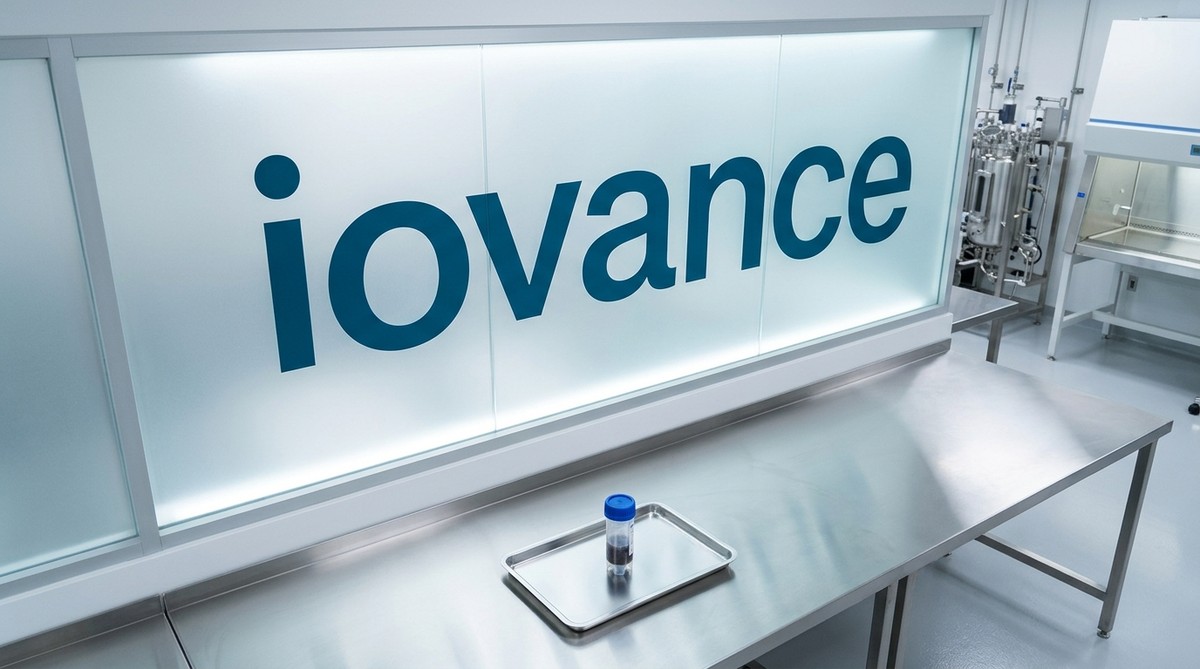
For most of its life, Iovance Biotherapeutics was a research project wearing a company’s clothes. It spent years and hundreds of millions of dollars teaching the immune system to fight cancer, with nothing to sell. Then, in early 2024, the FDA approved Amtagvi, the first tumor-infiltrating lymphocyte therapy ever cleared for commercial use, and the company crossed into a different kind of story. Revenue arrived. The losses, though, did not leave.
That tension sits at the center of every recent filing. A business can run at a loss while growing fast and still be on a credible path, if the math is moving in the right direction. The question the latest numbers raise is whether the math is moving fast enough, and whether the pipeline news announced in October and November 2026 changes that calculation.
The story, briefly
Iovance went from essentially zero revenue in 2023 to $264 million in full-year 2025, a genuine commercial launch. The company is still losing more than a dollar for every dollar it earns, meaning the business is not yet self-funding. The stock sits well below its 52-week high even after a strong run over the past year, a gap that reflects real uncertainty about how quickly losses narrow. New clinical data released in late October 2026 showed a striking split: a modest response rate in the broad lung cancer population, and a much higher one in a specific subgroup. Which number the market should believe is the open question.
What the filing shows: growth that still bleeds
The 10-Q for the quarter ended September 30, 2026 is the most recent filed period. Read alongside the full-year 2025 10-K, it tells a consistent story: revenue is growing at a pace that would double the business in roughly 18 months, but costs are growing alongside it. The net margin for 2025 was deeply negative, meaning that for every dollar Amtagvi brought in, the company spent about two and a half dollars in total. That is an improvement from the prior year, which is itself the right direction, but the distance left to travel is large.
Think of it this way: a restaurant that takes in $264 from a table but spends $660 to serve it is not yet a restaurant, it is a very expensive cooking school. The question is always whether the tuition eventually stops.
The loss per share has also been narrowing each year, each year a smaller bite out of the company’s cash. That trend is real and filed. What the filings cannot tell us is when the line crosses zero, and the dossier does not provide current cash balance figures, so we cannot say how many years of runway remain at the current burn rate.
The lung cancer data: two numbers that should not coexist
On October 29, 2026, Iovance released updated Phase 2 results for lifileucel in previously treated non-squamous metastatic lung cancer. Among the patients in the broad trial population, roughly one in four responded to treatment, meaning their tumors shrank by a measurable amount. That is meaningful in a disease where options are limited, but it is not a transformative result.
Inside that same trial, researchers identified a retrospective subgroup defined by specific biomarkers and smoking history. In that group, the response rate was 59.1%, more than double. Nearly six in ten patients responded, compared to roughly one in four across the full population.
Those two figures sitting side by side are the tension. A response rate approaching sixty percent in a well-defined subgroup is the kind of signal that can support a new indication and a much larger market. A one-in-four rate in an unselected population is harder to build a commercial franchise around. The critical word is “retrospective”: the subgroup was identified after the fact, by looking back at who responded and asking what they had in common. That method can find real signals, but it can also find patterns that dissolve when tested prospectively.
Iovance knows this. The company announced that enrollment for the POSITILITY trial, which will test the biomarker-enriched approach prospectively, is set to begin in November 2026, with a supplemental FDA application for lung cancer planned for 2027. A prospective trial is the only way to confirm whether the higher figure is a discovery or a statistical artifact.
What else is moving in the pipeline
Amtagvi also received Fast Track Designation from the FDA for soft tissue sarcomas, as reported in the August 2026 quarterly filing. Fast Track is a process designation, not an approval, but it means the FDA has agreed to work more closely with the company on the development path, which can shorten the time to a decision. Sarcomas are rare and difficult to treat, and an approval there would open a market that Amtagvi’s current melanoma label does not reach.
Earlier-stage programs, IOV-4001 and IOV-5001, are in Phase 1 and 2 trials for melanoma, lung cancer, and other solid tumors. These are years from any commercial decision and carry the full uncertainty of early-phase oncology work. Initial data from investigator-sponsored trials in two additional skin cancers are expected in the first half of 2027.
Reading the numbers
- $264 million, FY2025 revenue. What it is: total product sales for the full year ended December 31, 2025, the first full commercial year for Amtagvi. What it means here: the launch is real and accelerating, up 61% from 2024’s $164 million. In everyday terms: a business that earned roughly $13 per hour in 2024 was earning about $21 per hour by 2025, same product, more hospitals using it.
- Negative 148%, net margin for 2025. What it is: for every dollar of revenue, the company lost $1.48 after all costs. What it means here: the business is not yet self-sustaining, though the loss rate is shrinking each year. In everyday terms: a household earning $50,000 but spending $124,000 is not going broke today if it has savings, but the savings question matters enormously.
- 24.6% vs. 59.1%, lung cancer response rates. What it is: the share of patients whose tumors shrank meaningfully in the broad trial versus a biomarker-selected subgroup, as of October 14, 2026. What it means here: the gap between these two figures is the entire commercial argument for the lung cancer expansion. If the prospective POSITILITY trial confirms the higher number, the addressable market grows substantially. If it reverts toward the lower number, the 2027 FDA application becomes harder to build.
- $8.08, current share price, down 46% from the 52-week high. What it is: the market’s current price tag on the whole company, after a year in which the stock tripled. What it means here: the mood (what investors are currently paying) has cooled sharply from its peak even as the math (filed revenue growth and narrowing losses) has continued to improve. That divergence is not a recommendation in either direction; it is the fact that makes the story worth reading.
Sources
- 10-Q, quarter ended September 30, 2026
- 10-Q, quarter ended June 30, 2026
- 10-K, fiscal year ended December 31, 2025
- 10-K, fiscal year ended December 31, 2024
- Iovance October 29, 2026 clinical data release