
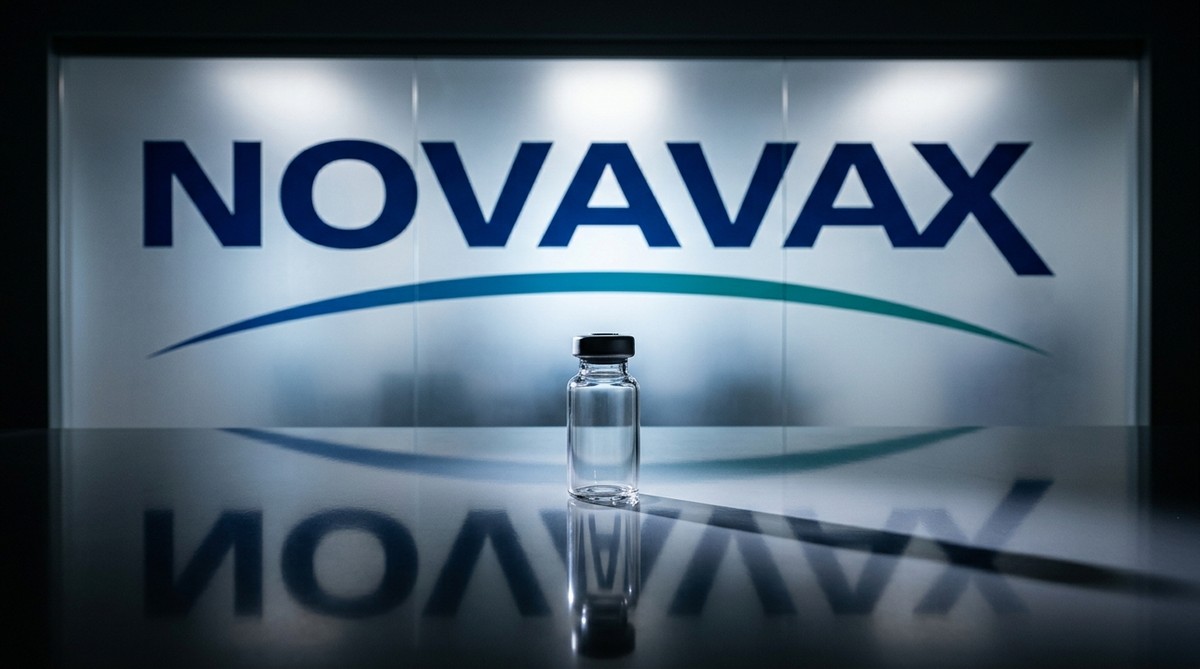
Novavax’s 10-K for fiscal year 2025 shows a net margin of 39.2% and earnings per share of $2.58. The stock trades at roughly three and a half times those earnings. That combination, a profitable biotech priced as though the profit might vanish, is unusual enough to deserve a close look at what the filings actually say.
To understand why the market is skeptical, you have to know where Novavax came from. The company spent most of its life losing money on a COVID-19 vaccine that arrived late to a crowded party. Shares touched a peak in late 2021, when the world was still desperate for every vaccine it could get, then collapsed to an all-time low in early 2024 as COVID demand dried up and the company burned through cash faster than it earned it. The company that just posted a profitable year is not the same business that peaked in 2021. It has shed its commercial infrastructure, handed distribution to partners, and is betting its future on a technology platform rather than a single product. That transformation is the story the filings tell, and the market has not fully decided whether to believe it.
What the numbers say
The math, what the filed fundamentals show, is a company that turned profitable in 2025 after four consecutive years of losses, carries enough cash to fund roughly three and a half years of operations at its current burn rate, and trades at a price-to-earnings ratio of 3.5, barely above its own decade median. The mood, what the market is currently paying, prices the stock as though that profitability is a one-time event rather than a structural shift. The open question is whether the 2025 profit reflects a durable new business model or a lucky year of milestone payments that will not repeat.
How a Vaccine Maker Became a Platform Licensor
The physical scene that defines Novavax today is not a factory floor filling vials. It is a licensing agreement. In January 2026, Novavax signed a deal with Pfizer to license its Matrix-M adjuvant technology, the immune-boosting ingredient that makes its vaccines work, for two infectious disease areas. Pfizer paid $30 million upfront and agreed to potential milestones that could reach $500 million. An adjuvant, for readers unfamiliar with the term, is a chemical added to a vaccine that amplifies the immune response, the way a megaphone amplifies a voice. Novavax’s version, Matrix-M, is considered one of the more effective ones available, and it is now the company’s most valuable asset.
Sanofi handles commercial sales of the COVID-19 vaccine, Nuvaxovid, in most markets. Takeda covers Japan. Novavax collects royalties and milestone payments without running a sales force. In August 2026, those partners secured approvals for the updated Nuvaxovid targeting the XFG variant of SARS-CoV-2 across the U.S., EU, and Japan for the 2026-2027 vaccination season. Novavax earns from that approval without bearing the cost of the commercial launch. That is the new model, and the 2025 annual results are its first full-year test.
The Burn Underneath the Profit
Here is where the filed numbers get complicated. The 2025 full-year profit was real, but the most recent quarter tells a different story. The 10-Q for the quarter ended June 30, 2026 shows an operating loss that exceeded the quarter’s entire revenue. Q2 is historically Novavax’s quietest quarter, before the autumn vaccination season drives most of its annual revenue, so a single quarter’s loss does not invalidate the annual picture. But it illustrates the seasonal lumpiness that makes this business hard to read.
R&D spending in Q2 alone surpassed the quarter’s entire revenue. Think of it this way: the company spent more on research in three months than it brought in the door. That is not unusual for a biotech building a pipeline, but it means the quarterly cash burn is real. For the first half of 2026, the 10-Q filed for the period ended June 30, 2026 shows net cash used in operations of $105.2 million. Against a cash position of $723.9 million as of June 30, our data puts the runway at roughly three and a half years at that pace, meaningful breathing room, but not unlimited.
The debt side matters too. Long-term debt stood at $291.5 million as of June 30, 2026. That is not a crushing load relative to the cash on hand, but it is a real obligation sitting alongside the burn.
What the Conversation Is Getting Right, and What It Might Be Missing
MarketBeat reported on September 10, 2026 a consensus “Hold” rating from nine analysts, with an average 12-month analyst valuation estimate of $14.00, above the then-current share price of $9.85. Cantor Fitzgerald reiterated a “Buy” in early August 2026, according to Stock Analysis. Bank of America held a “Sell” the same day. The spread across individual analyst estimates, from single digits to the mid-twenties, is itself a signal: the people paid to model this company disagree sharply about what it is worth, which usually means the outcome depends on assumptions that the filed numbers cannot yet resolve.
The bull case rests on milestone payments. Sanofi and Pfizer together could pay out hundreds of millions in contingent milestones. If even a fraction of those flow in, the 2025 profit looks less like a one-time event and more like the beginning of a recurring stream. The bear case is that COVID vaccine demand keeps shrinking, the milestone payments are contingent and distant, and the quarterly burn is structural rather than seasonal.
The filed numbers cannot settle that argument. What they can say is that the company entered 2026 with more cash than its annual operating expenses, a positive full-year earnings record for the first time in its history as a COVID-era company, and a pipeline that includes a C. difficile vaccine candidate selected for clinical advancement as early as 2027, according to Chain Drug Review. Whether those facts justify the current price or something twice as high depends on how much weight a reader places on the seasonal revenue pattern versus the quarterly burn, and on whether the Matrix-M licensing deals prove to be a genuine second act or a bridge to nowhere.
Reading the Numbers
- FY2025 net margin: 39.2%. This is the share of each dollar of revenue left after all costs, including R&D, overhead, and taxes. A 39% margin means that for every dollar Novavax brought in last year, it kept about 39 cents as profit. For a company that lost money in each of the four prior years, this is the number that changed the story. It is filed in the FY2025 10-K.
- Q2 2026 operating loss: $68.6 million on $56.7 million revenue. Operating loss is what remains after subtracting the cost of making the product and all operating expenses from revenue. A loss larger than revenue means the company spent nearly twice what it earned in the quarter. A household analogy: earning $2,800 in a month but spending $5,400 on rent, groceries, and bills combined. The Q2 filing shows this is largely driven by $70.7 million in R&D, a deliberate investment in future pipeline rather than a sign of operational failure, but it is a real cash outflow. Filed in the Q2 2026 10-Q.
- Cash runway: roughly 3.4 years at current burn. With $723.9 million in cash and equivalents and $105.2 million used in operations in the first half of 2026, our data puts the runway at about 13 to 14 quarters. That is enough time for the autumn 2026 and 2027 vaccination seasons to either validate or challenge the licensing model before the company faces a funding question.
- P/E ratio: 3.5, at the 72nd percentile of its own decade. A price-to-earnings ratio is the price tag per dollar of annual profit. At 3.5, the market is paying $3.50 for every $1 Novavax earned last year. The S&P 500 typically trades above 20 times earnings. Novavax’s own decade median is 3.2, so today’s price is slightly above its historical norm, but still far below what a typical profitable company commands. That gap reflects the market’s doubt about whether the 2025 profit repeats, computed from our data.
Reading the numbers
Three figures carry most of the weight in this article, and each one pulls in a different direction.
39.2% net margin (FY2025). Net margin is the percentage of revenue a company keeps as profit after every cost has been paid. At 39.2%, Novavax kept nearly 40 cents of every dollar it earned in 2025. That is a high margin for any industry, let alone a biotech that was losing money as recently as 2024. It matters here because it is the single fact that separates Novavax from the distressed-company story the stock price implies. Without it, the low P/E ratio would simply mean a broken business. With it, the low P/E becomes a puzzle worth examining.
$68.6 million operating loss on $56.7 million revenue (Q2 2026). Operating loss is what is left after subtracting the cost of running the business from revenue. When the loss exceeds revenue, the company spent more than it earned before even accounting for interest or taxes. This number matters because it complicates the profitable-year story: the most recent quarter shows the company burning cash at a rate that would erase the annual profit if sustained. The mitigating context is that Q2 is Novavax’s seasonally weakest quarter, and $70.7 million of that spending was R&D, a deliberate investment rather than overhead waste. But it is the number that gives the bear case its teeth.
$723.9 million cash, implying roughly 3.4 years of runway. Cash runway is how long a company can keep operating at its current spending rate before it runs out of money. At $105.2 million burned in the first half of 2026, Novavax has enough cash to last into late 2029 without raising new funds. This number moves the story because it sets the clock. If the autumn vaccination seasons of 2026 and 2027 generate the milestone payments the bull case expects, the runway extends and the model is validated. If they do not, the runway is finite and the funding question becomes real. The cash balance is the margin of safety that makes this a debate rather than a verdict.
Sources
- Novavax 10-Q, Q2 2026 (SEC EDGAR)
- Novavax 10-K, FY2025 (SEC EDGAR)
- Novavax 8-K, Pfizer Matrix-M licensing deal (SEC EDGAR)
- Novavax XFG variant approvals press release (PR Newswire)
- MarketBeat analyst consensus, September 10, 2026
- Stock Analysis: NVAX analyst forecasts
- Chain Drug Review: Nuvaxovid 2026-2027 approvals
- Novavax Q2 2026 results press release (PR Newswire)
- Stock Analysis: NVAX company overview and history