
Abbott Laboratories spent the better part of five years rebuilding its identity. The pandemic turned its diagnostics business into a cash machine, then the cash machine switched off, and revenue fell sharply in 2023 as COVID test demand collapsed. The company responded the way large industrials usually do: it leaned on its other businesses, launched new products, and went shopping. In March 2026, it completed a roughly $21 billion acquisition of Exact Sciences, a cancer-diagnostics company, betting that the next growth chapter would be written in oncology rather than infectious disease. The bet is early. The stock, meanwhile, has fallen about 18% year-to-date, even as the S&P 500 climbed roughly 13%. Two things are happening at once that should not both be true, and the gap between them is the story.
What the numbers say
The filed numbers show a business growing faster than it was a year ago, with management raising its own earnings targets mid-year. The stock price, down roughly 18% year-to-date, implies that investors expect something closer to stagnation. Those two readings sit in direct tension, and the open question is which one is wrong: the filed momentum, or the market’s skepticism about whether it lasts.
Five years of whiplash
To understand where Abbott sits today, it helps to watch the revenue line move. The 10-K for fiscal year 2025 shows revenue of $44.3 billion, up about 6% from the prior year, recovering ground lost when the COVID diagnostics windfall faded. That windfall was real: revenue surged in 2021, then flatlined, then fell hard in 2023 as hospitals stopped bulk-ordering COVID tests. The core businesses, devices, nutrition, and pharmaceuticals, never went away. They were just hidden under the noise.
The Exact Sciences acquisition adds a new layer. Abbott financed it with a large senior notes offering that increased its total debt load by roughly 2.6 times in a single quarter. That is a meaningful shift for a company that had spent three years paying debt down. The acquisition also diluted near-term earnings by about $0.20 per share in 2026, which is the cost of buying future growth today. What Abbott got for that price: a cancer-diagnostics franchise that grew at a double-digit comparable rate in the most recent quarter, according to the Q2 2026 earnings release. That is fast enough to matter.
Where the growth is actually coming from
Abbott runs four businesses. Three of them are growing. One is not.
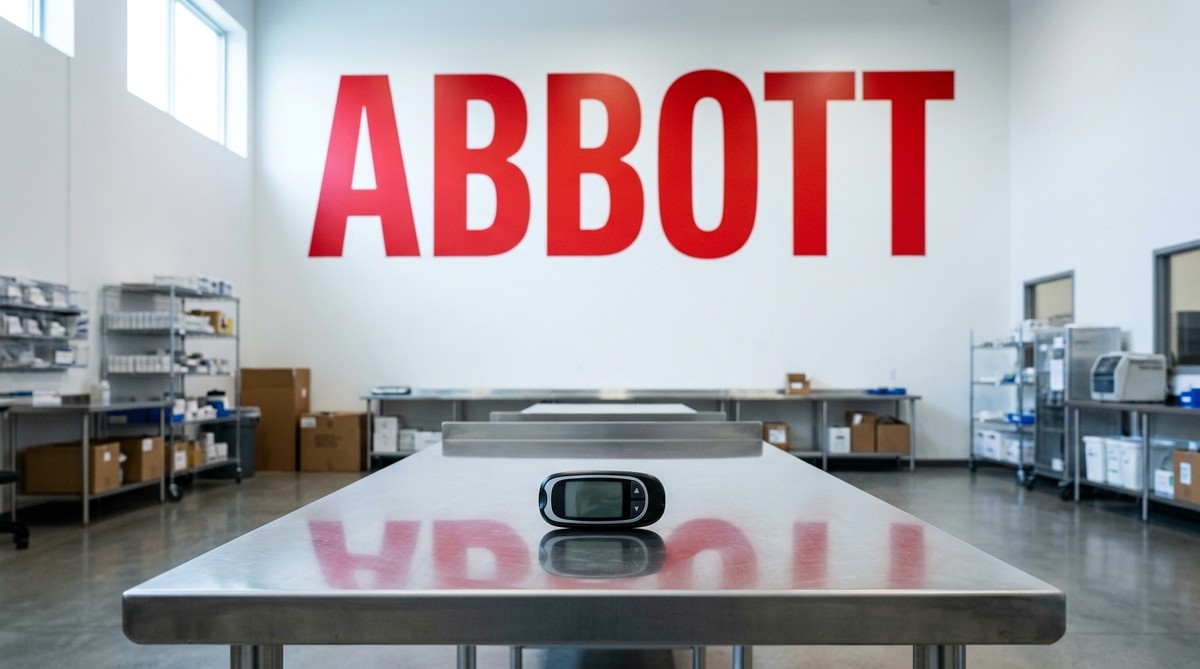
Medical Devices, the largest and most watched segment, grew at a healthy high-single-digit pace in Q2 2026, led by electrophysiology, cardiac rhythm management, and diabetes care. The diabetes care story centers on FreeStyle Libre, the continuous glucose monitor worn on the back of the arm that reads blood sugar without finger pricks. Abbott has received FDA clearance for FreeStyle Libre 2, FreeStyle Libre 3, and, in August 2026, the Libre Duo, which tracks both glucose and ketones simultaneously. The device is a genuine franchise, which makes the January 2026 FDA warning letter about manufacturing and quality-control failures at the FreeStyle Libre facility a genuine complication. That letter, issued by the FDA on January 23, 2026 and published February 3, 2026, and an associated recall of certain Libre 3 sensors linked to incorrect low-glucose readings, put the segment’s reputation under scrutiny even as its sales kept climbing.
Established Pharmaceuticals, which sells branded generics mostly in emerging markets, also grew at a healthy clip in Q2. Nutrition, which includes infant formula, declined. A September 2026 Seeking Alpha report, citing company disclosures BullScope has not independently verified, described a $385 million proposed settlement to resolve claims tied to its 2022 infant formula recall, with the government reported to have closed its criminal investigation; readers should consult Abbott’s primary filings for confirmed terms before treating this figure as established fact. That settlement, if confirmed, is reported to remove a legal cloud, but the nutrition segment’s underlying volume remains soft.
Three of four segments growing at mid-to-high single digits is a reasonable operating picture. The question is what the market thinks it is worth.
The math and the mood
“The math” is what the filed numbers justify; “the mood” is what the market is currently paying. Right now they point in opposite directions.
On the math side: the 10-Q for the quarter ended June 30, 2026 shows free cash flow of $7.8 billion over the trailing twelve months, which is more than Abbott earns in net income in a typical year and signals that the business converts its profits into real cash reliably. Abbott raised its full-year 2026 adjusted EPS guidance in July, citing five consecutive quarters of beating analyst expectations. The FactSet consensus as of September 2026 sits essentially in line with management’s own floor, and the forward consensus implies continued double-digit earnings growth into 2027.
On the mood side: the stock has fallen about 18% year-to-date while the healthcare sector gained roughly 14%. Our data show Abbott’s price-to-sales ratio at the 10th percentile of its own decade range, meaning the market is pricing Abbott’s revenue more cheaply than it has in nine of the last ten years. The P/E ratio sits near the middle of its own history, but that figure uses reported earnings, which in 2024 were inflated by a one-time item. Strip that out and the earnings base looks considerably thinner than the headline multiple suggests, putting the current price at a much higher multiple of what the business actually earned last year.
Barclays analyst Matt Miksic, cited by 247 Wall St. on August 3, 2026, maintained an analyst valuation estimate of $143, arguing that acquisition costs have masked five consecutive adjusted EPS beats. That framing is consistent with the adjusted-earnings trend in the filed results; whether adjusted figures are the appropriate basis for valuation is a separate analytical question the market appears to be weighing.
What the price is assuming
Abbott’s own decade median valuation multiple, per our data, is meaningfully higher than where the stock trades today relative to forward earnings. The gap between those two figures is large enough to carry a story of its own. Either the market believes earnings will disappoint relative to consensus, or it is applying a structurally lower multiple because of the debt load, the Libre recall risk, or the integration uncertainty around Exact Sciences. Possibly all three.
IF full-year 2026 adjusted EPS lands at the midpoint of Abbott’s own guidance range of $5.45–$5.60 (per the Q2 2026 earnings release) AND the market applies Abbott’s decade-median forward P/E of approximately 24x (per our published methodology), the arithmetic would place the implied price in a range of approximately $131 to $134, a scenario that depends on both conditions holding. If earnings disappoint, or if the market decides the new debt load warrants a permanently lower multiple, the current price makes more sense. The data cannot resolve which outcome arrives. What it can say is that the price today reflects a degree of pessimism that the filed operating results, through the most recent quarter, have not yet confirmed; whether that pessimism is forward-looking or misplaced is a question the data leaves open.
Reading the numbers
- $44.3 billion in FY2025 revenue (filed in the 2025 10-K). What it is: total sales across all four segments for the year. What it means here: revenue has recovered to above its pre-COVID-windfall level, suggesting the core business is intact. Everyday version: a company that earns $44 billion a year is roughly the size of the entire economy of a mid-sized American city, generating that much in sales every twelve months.
- $7.8 billion in trailing free cash flow (from the Q2 2026 10-Q). What it is: cash left over after the company pays its operating costs and capital expenses, before dividends and debt payments. What it means here: Abbott generates enough cash each year to pay off roughly a quarter of its new acquisition debt without touching its operating budget. Everyday version: a household earning $78,000 a year after all bills, available to pay down a mortgage or reinvest.
- $34 billion in total debt as of March 2026 (from the Q1 2026 10-Q). What it is: money owed to bondholders, up from $13 billion at year-end 2025. What it means here: Abbott borrowed more in one quarter than it had accumulated over the prior three years combined. Everyday version: a family that carried a $13,000 credit card balance in December and ran it to $34,000 by April to buy a business they believe will pay off. The bet may be right; the balance is real either way.
- P/S ratio at the 10th percentile of its own decade (our data). What it is: the price-to-sales ratio, meaning how many dollars the market pays for each dollar of Abbott’s annual revenue, compared to where that ratio has stood over the past ten years. What it means here: the market is pricing Abbott’s sales more cheaply than it has in nine of the last ten years. Everyday version: a store that used to sell for ten times its annual revenue is now selling for six times, even though revenue is growing.
For the standing yardsticks on Abbott Laboratories: the price tag, the filed record, and the four gauges, refreshed with each edition, see the BullScope Evidence Sheet: Abbott Laboratories.
For the standing yardsticks on Target: the price tag, the filed record, and the four gauges, refreshed with each edition, see the BullScope Evidence Sheet: Target.
For the standing yardsticks on Dow: the price tag, the filed record, and the four gauges, refreshed with each edition, see the BullScope Evidence Sheet: Dow.
Sources
- Abbott 10-Q, quarter ended June 30, 2026 (SEC EDGAR)
- Abbott 10-Q, quarter ended March 31, 2026 (SEC EDGAR)
- Abbott 10-K, fiscal year ended December 31, 2025 (SEC EDGAR)
- Abbott Q2 2026 earnings release, PR Newswire, July 16, 2026
- FDA warning letter, Abbott Diabetes Care, January 23, 2026
- 247 Wall St., Barclays / Matt Miksic commentary, August 3, 2026
- MarketScreener, FactSet consensus EPS estimates, September 2026
- Seeking Alpha, Abbott infant formula settlement report (secondary source; primary filing not independently verified by BullScope), September 2026