
A stock sitting well below its 52-week high while posting the best operating margin in at least seven years. Those two facts should not coexist, and the gap between them is exactly where this story lives.
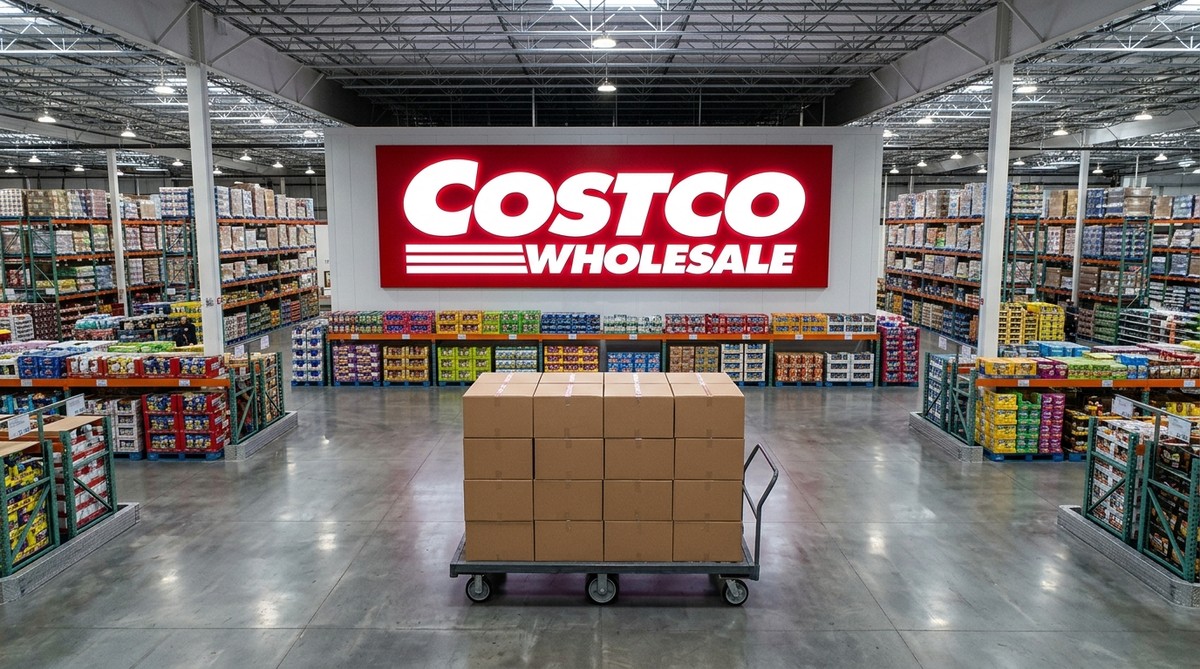
Costco has spent four decades building one of retail’s most durable machines: a warehouse model that sells goods near cost, then earns its profit from the annual membership fee every shopper pays just to walk in the door. The fee is the engine. Everything else, the rotisserie chickens, the $1.50 hot dogs, the pallets of olive oil, is the reason members keep renewing. For most of its history, the market priced that engine at a premium. Today it still does, but the premium has a number attached to it, and that number carries assumptions worth examining.
The quick read
The 10-K filed October 7, 2026 shows Costco growing revenue at a double-digit pace and earning its widest operating margin in years. The stock, at roughly $948, trades at about 51 times last year’s earnings, a multiple that sits near the high end of its own decade range. The price assumes the strong results keep coming without interruption. The open question is whether a business already operating near peak efficiency can keep surprising to the upside, or whether the current price has already borrowed tomorrow’s good news.
Claim one: “Costco’s fundamentals justify a premium multiple”
This is the most repeated line in the bull case, and the filings largely support it. The fiscal year 2026 10-K shows total revenue of $303.2 billion, up 10% from the prior year, with membership fee income growing at an even faster clip. Operating margin reached 3.9%, its highest in at least seven years according to management’s own commentary on the Q4 2026 earnings call. Comparable sales grew solidly for the full year, driven by both more visits and bigger baskets.
The membership engine is the number that matters most here. A 92.3% renewal rate in the U.S. and Canada, reported at the Q4 earnings release, means roughly nine of every ten members who joined last year paid again. That is not a loyalty metric, it is a revenue guarantee. And the September 2024 fee increase, the first since 2017, still has runway: the pricing power is real and recently demonstrated, with a meaningful share of membership income growth in fiscal 2026 traceable directly to that single decision.
So the fundamentals are strong. The question is whether “strong” is already fully priced in, or whether there is still a gap between the math and the mood. The math is what the filed numbers justify; the mood is what the market is currently paying. Right now, the mood is generous.
Claim two: “The valuation is stretched”
Kenio Fontes, writing for Seeking Alpha on September 25, 2026, argued that “the market already prices in double-digit growth, leaving little room for upside or negative surprises.” A separate Seeking Alpha piece on October 5, 2026, framed the tension as a gap between business quality and entry price: at more than 40 times forward earnings, the author contended the valuation had outrun the fundamentals. Truist analyst Scot Ciccarelli, per Seeking Alpha’s October 8 coverage, cited the elevated market value and a slowing membership growth rate as reasons for caution. These perspectives represent one side of a genuine analytical debate; the filed numbers that inform the other side are examined below.
Our data puts the current price-to-earnings ratio at 51.2 times, against a decade median of 50.6. That sounds almost fair, until you notice what the decade median was built on: years when Costco was growing faster from a smaller base. Today’s revenue growth is genuinely impressive for a business of this scale, but the company posted a considerably faster rate just a few years ago. The multiple has barely moved even as the growth rate has moderated.
Think of it this way: a buyer at today’s price is paying about $51 for every dollar Costco earned last year. A decade ago, that same dollar cost roughly the same amount, but the company had far more room to run. The price has stayed elevated while the growth ceiling has risen into view.
That said, the bear case has a real weakness. Costco’s e-commerce operation, which exceeded $33 billion in digitally-enabled sales in fiscal 2026 and grew more than 20% for the year, is not in most people’s mental model of a warehouse retailer. Neither is the international margin story: Canada’s operating margin has run well above the U.S. segment over recent fiscal years. These are real, filed sources of incremental value that a simple multiple comparison can miss.
Claim three: “International expansion is a growth driver”
Management said on the Q4 earnings call that Costco plans 33 new warehouses in fiscal 2027, including five relocations, with a longer-term target of 30 net new locations per year. Capital expenditures for fiscal 2027 are estimated at $7.5 billion—equivalent to roughly 80% of fiscal 2026 net income—which is a meaningful commitment.
The filed comparable sales data from the Q4 operating results release shows adjusted comp growth running at a similar pace across the U.S., Canada, and Other International for fiscal 2026. The consistency across regions is notable: this is not a story of one geography carrying the others. But with membership count growing at under 4% per year globally, the fee increase and higher renewal rates are doing more work than new member acquisition right now.
As of early October 2026, analyst price targets in MarketScreener’s consensus data spanned a wide range, with the upper end exceeding $1,100 and at least one major firm revising its target downward in late September while retaining a constructive view on the business. The spread between those targets reflects genuine disagreement about how much the expansion plan is worth at today’s capital cost; the filed data can confirm that the expansion is funded and planned, but cannot resolve the valuation debate.
Reading the numbers
$303.2 billion in total revenue, fiscal year 2026. What it is: the sum of everything Costco sold plus membership fees. What it means here: Costco is now larger than the entire economy of many mid-sized countries, which makes each additional percentage point of growth harder to find. Worked example: growing 10% on this base requires finding the equivalent of a new $30 billion business every year, roughly the annual sales of a large regional grocery chain, added on top of what already exists.
3.9% operating margin, fiscal year 2026. What it is: the share of each sales dollar left after paying for goods, staff, and running the warehouses, before interest and taxes. What it means here: Costco keeps less than four cents of every dollar it rings up, which sounds thin until you realize that on $300 billion in sales, thin margins still produce enormous absolute profits. Worked example: a hardware store keeping 3.9 cents on every dollar of a $500 purchase clears about $19.50 on that transaction. Multiply that by hundreds of millions of transactions and the math becomes compelling.
P/E of 51.2, against a decade median of 50.6. What it is: the price-to-earnings ratio, meaning the price tag per dollar of annual profit (the multiple). What it means here: the market is paying almost exactly what it has paid on average for the past decade, despite the growth rate being lower today than it was for much of that period. Worked example: a landlord who always charged 50 times annual rent for a building is now charging the same multiple even though the building’s rent growth has slowed. The price feels familiar, but the growth assumption behind it has quietly changed.
92.3% U.S. and Canada renewal rate. What it is: the share of members who paid their annual fee again when it came due. What it means here: membership income is close to a fixed annuity, predictable enough to plan around. Worked example: if a neighborhood gym had 1,000 members and 923 renewed every year without being asked twice, the gym’s owner could budget next year’s revenue before January 1.
For the standing yardsticks on Costco Wholesale: the price tag, the filed record, and the four gauges, refreshed with each edition, see the BullScope Evidence Sheet: Costco Wholesale.
Sources
- Costco 10-K, fiscal year ended August 30, 2026 (SEC EDGAR)
- Costco Q4 and FY2026 operating results press release
- Costco Q4 2026 earnings call transcript (The Motley Fool)
- Seeking Alpha, Kenio Fontes, September 25, 2026
- Seeking Alpha news, October 8, 2026 (Truist/Ciccarelli)
- MarketScreener analyst consensus, October 2026
- The Motley Fool on Costco membership fee history and e-commerce