
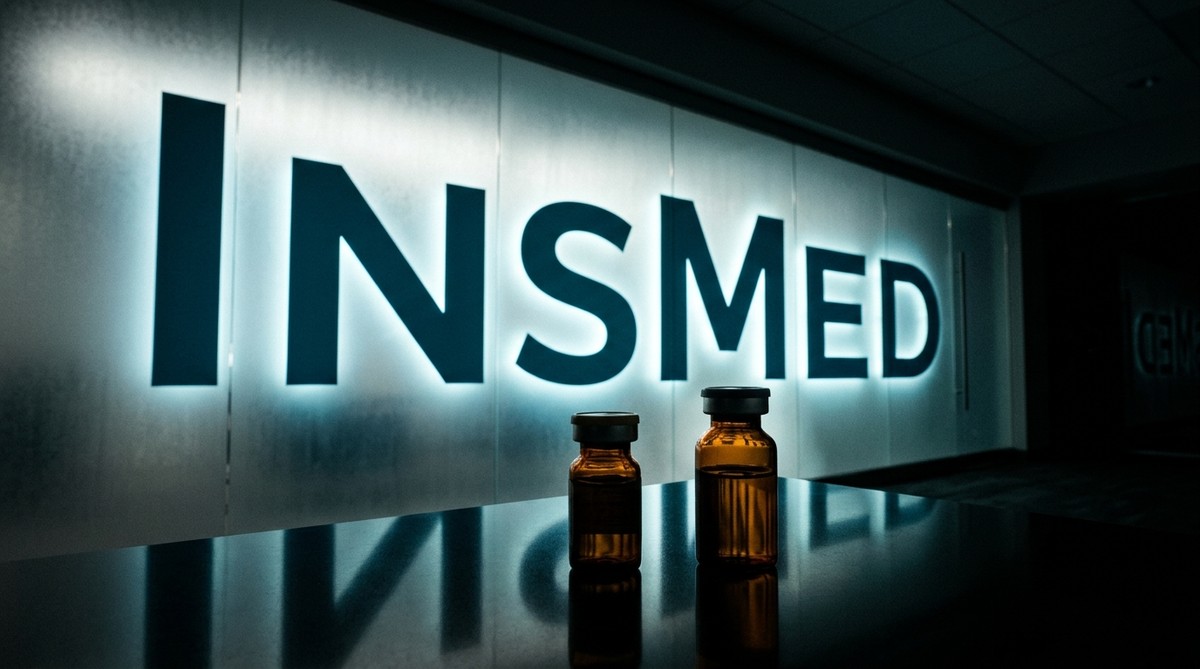
A year ago, Insmed traded above $210. Today it sits near $105, cut in half, even as the company just reported its best quarter ever. That gap between a business accelerating and a stock retreating is the tension this piece is about.
Insmed makes medicines for rare lung diseases, the kind that affect small patient populations and carry price tags to match. For most of its life it was a one-drug company, living off ARIKAYCE, an inhaled antibiotic for a stubborn bacterial infection called MAC lung disease. Revenue grew steadily but the losses never stopped, because the company kept betting its future on a second drug, brensocatib, that spent years in clinical trials. That bet paid off in August 2025, when the FDA approved BRINSUPRI, the brand name for brensocatib, as the first treatment ever approved for non-cystic fibrosis bronchiectasis, a chronic lung condition affecting hundreds of thousands of Americans. The approval turned Insmed from a slow-growth specialty company into something that looks, at least on the revenue line, like a rocket.
The gist of it
The filed numbers show a business that nearly doubled its revenue in a single year and is now losing far less money per quarter than it was twelve months ago. The stock is priced above its own historical median on a price-to-sales basis, even after falling by half from its peak. The open question is whether the revenue acceleration is real and durable enough to justify paying that premium for a company that has never turned a profit.
What the filings actually show
The 10-K for fiscal year 2025 shows total revenue of $606 million, up 67% from the year before. That is not a rounding error or an accounting adjustment. ARIKAYCE contributed the majority, growing at a steady clip. BRINSUPRI, which only launched in August 2025, added meaningful revenue in roughly four months of commercial sales. Two products, two very different growth profiles, one company.
The more recent story is in the 10-Q for Q2 2026, filed in August. A single quarter brought in $425 million in revenue, with BRINSUPRI alone jumping nearly half again over the prior quarter. To put that in proportion: the entire company used to earn in a full year what it now earns in three months.
The gross margin, meaning what is left of each dollar of sales after the direct cost of making the medicine, came in at about 84% for Q2 2026. That is a high-quality number. For every dollar a patient or insurer pays, Insmed keeps roughly 84 cents before paying its scientists, salespeople, and executives. The problem is that those scientists and salespeople are expensive. Operating expenses for the quarter exceeded revenue, which means the company spent more than it earned, even at that margin. Research and development alone consumed more in a single quarter than the whole company earned in revenue in all of 2020.
The net loss for Q2 2026 was $13 million, which sounds alarming until you compare it to the losses of prior years. The 2024 annual filing shows a full-year net loss of roughly $915 million. Losing $13 million in a single quarter is, for Insmed, a near-miraculous improvement. The direction of travel is unmistakable, even if the destination is not yet in sight.
Cash on hand as of June 30, 2026 was $1.2 billion, which at the current burn rate gives the company meaningful runway. The 10-K for fiscal year 2025 shows total debt at year-end 2025 had fallen substantially from the prior year. The company is not running out of money. It is spending heavily on purpose, trying to build a commercial and scientific infrastructure that can support multiple products across multiple countries.
The mood around the stock
Here is where the math and the mood, meaning what the filed numbers justify versus what the market is currently paying, pull in different directions. The stock is down sharply from its 52-week high, according to our data. And yet the price-to-sales ratio, which is the price tag per dollar of annual revenue, sits above Insmed’s own historical median, per our data. The stock has been cut in half and is still not cheap by its own standards.
That seems contradictory until you account for the denominator. Revenue is growing so fast that even a falling stock price cannot keep the valuation ratio low. A year ago, the market was paying a very high multiple on much smaller revenue. Today it is paying a somewhat high multiple on much larger revenue. The ratio compressed, but not because the stock got cheap. It compressed because the business got bigger faster than the price fell.
BMO Capital, reiterating an Outperform rating on October 6, 2026, said the reaffirmed 2026 guidance reduced concerns about a CFO transition announced that same week. Goldman Sachs initiated coverage with an Outperform-equivalent rating on September 24, 2026, according to the dossier. The analyst consensus, as reported by the dossier, clusters around price targets roughly double where the stock trades today. BullScope does not endorse those targets or any others. We note them because the gap between where analysts see fair value and where the stock actually trades is itself a data point about how much uncertainty the market is currently pricing in.
That uncertainty has a name: the CFO departure. Insmed announced on October 5, 2026 that CFO Sara Bonstein would be leaving. Leadership changes at companies still burning cash tend to rattle investors, because the CFO is the person managing the runway. The company reaffirmed its 2026 guidance in the same announcement, which BMO read as a stabilizing signal. The market, at least in the days since, has not fully agreed.
The question the numbers cannot answer
Insmed’s management, as reported by Market Chameleon on October 5, 2026, anticipates reaching cash-flow positivity in 2027. The filed numbers are consistent with that timeline being plausible. They do not make it certain. The company is still spending more than it earns, and the research line is not shrinking. A Phase 3 study for a drug called TPIP in pulmonary fibrosis is set to begin in the second half of 2026, and another in early 2027. Each new trial is another draw on the cash account.
The ARIKAYCE supplemental application, seeking expanded approval for a broader group of MAC lung disease patients, was accepted for FDA Priority Review in September 2026, with a decision expected in January 2027. Japan approved BRINSUPRI for bronchiectasis in August 2026. These are real milestones, not projections. What they are worth commercially depends on uptake rates, pricing negotiations with payers, and competitive dynamics that no filing can predict.
A company spending heavily on research while losing only a small amount per quarter overall is threading a very specific needle. The needle is getting easier to thread. Whether it gets threaded completely is the question the current price is trying to answer.
Reading the numbers
- $425.5 million, Q2 2026 revenue (from the 10-Q filed August 6, 2026). What it is: total product sales in a single quarter. What it means here: the company earned more in three months than it did in all of 2022. In everyday terms: a neighborhood bakery that used to sell 100 loaves a week is now selling 170, and the ovens are still running hot.
- 84% gross margin, Q2 2026. What it is: the share of each revenue dollar left after paying to manufacture the product. What it means here: the medicines themselves are highly profitable; the losses come from the cost of building the business around them. In everyday terms: a contractor who charges $1,000 for a job and spends $160 on materials keeps $840, but then pays wages, insurance, and equipment on top of that.
- $13.2 million net loss, Q2 2026. What it is: the bottom-line shortfall after all costs. What it means here: compared to a full-year loss of roughly $915 million in 2024, losing $13 million in a quarter represents a dramatic narrowing. In everyday terms: a household that used to overdraw its account by $9,000 a month is now overdrawing by $130.
- 21 times price-to-sales, current (our data). What it is: the price tag investors are paying per dollar of annual revenue. What it means here: above Insmed’s own historical median of about 19 times, even after the stock fell 50% from its peak. In everyday terms: a used car priced above its own average resale value, even after a dent.
- $1.2 billion cash, June 30, 2026. What it is: liquid reserves. What it means here: at recent spending rates, this covers roughly a year of operations, giving the company time to reach the profitability timeline it has described without needing to raise new money immediately. The data cannot say whether that timeline holds.
Sources
- 10-Q for quarter ended June 30, 2026 (SEC EDGAR)
- 10-K for fiscal year ended December 31, 2025 (SEC EDGAR)
- 10-K for fiscal year ended December 31, 2024 (SEC EDGAR)
- FDA approval of BRINSUPRI, August 12, 2025 (Insmed investor relations)
- CFO transition announcement, October 5, 2026 (Insmed investor relations)
- 2026 guidance reaffirmation, October 5, 2026 (Market Chameleon)
- BMO Capital reiterates Outperform, October 6, 2026 (Investing.com)
- Insmed stock slides on CFO exit (TradingView, citing Benzinga)