

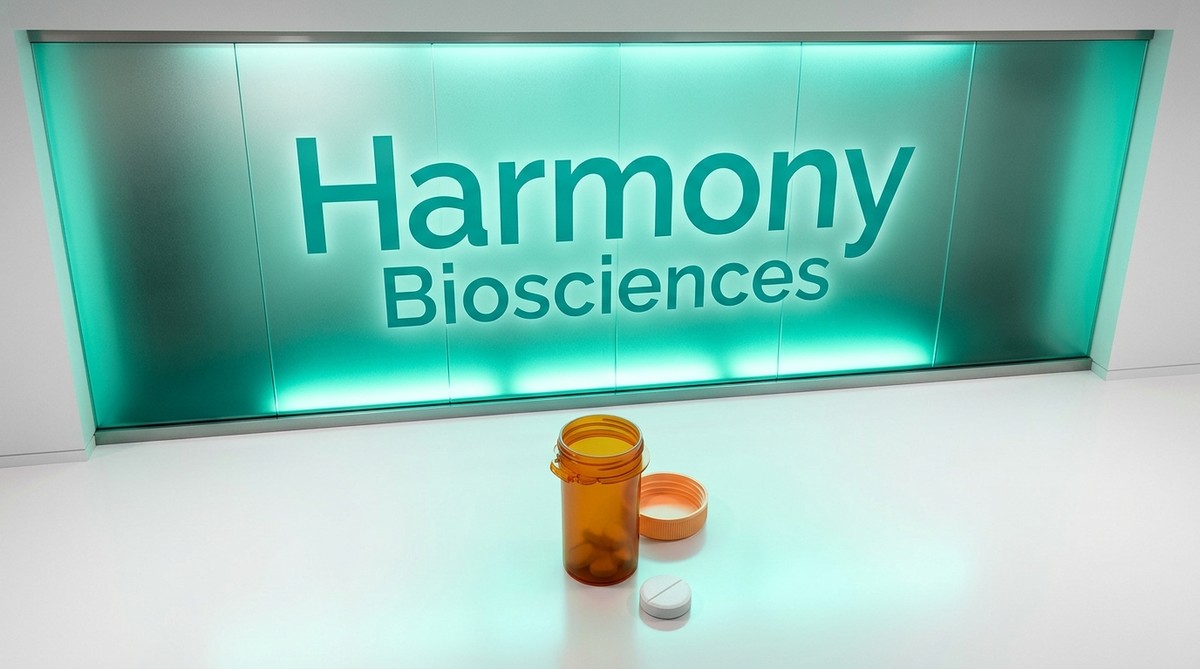
Harmony Biosciences went public in August 2020 selling a single approved drug to a small population of narcolepsy patients. Six years later, that same drug is on track to cross a billion dollars in annual sales, and the company is racing to build a second act before patent protection runs out. That race is what makes the current quarter worth reading carefully.
The quick read
WAKIX is growing faster than the company’s own recent trend, and the filed numbers show margins holding even as the pipeline spending rises. The price-to-sales ratio currently sits at 2.8 against a historical median of 4.2, a gap that, if the historical relationship were to reassert itself and revenue held near current levels, would represent a meaningful difference in implied price. Whether that gap reflects a genuine discount or a rational reassessment of post-2030 durability is the question the pipeline data will begin to answer. The open question is whether the pipeline assets in motion can replace WAKIX before 2030, when patent protection narrows sharply. Those two readings, a business gaining momentum and a market pricing in doubt, are the tension here.
What the quarter actually showed
The 10-Q filed August 4, 2026 put WAKIX net product revenue at $261 million for the three months ended June 30, 2026, up 30% from the same quarter a year earlier. To feel that number: WAKIX is now earning in a single quarter well over what the entire company earned in its first full year of public life. The sequential jump from Q1 was unusually steep for a drug already past its launch phase.
Management reiterated full-year 2026 WAKIX guidance of $1.0 billion to $1.04 billion, as reported in the August earnings call transcript. Nearly nine thousand patients were on therapy in the quarter. That patient count matters because it tells you the revenue growth is coming partly from more patients, not just price, which is a healthier signal for durability.
The 10-K for fiscal year 2025 shows net margin at 18%, down from a peak reached in 2022. The compression is real, driven by pipeline spending, but the margin has not continued to slide sharply, holding in the high teens to low twenties across recent annual filings. A business that earns roughly eighteen cents on every dollar of sales, while funding multiple clinical programs, is not in distress. It is choosing investment over extraction, and the filed numbers support that reading.
What changed in the pipeline
The biggest addition is also the smallest thing on the shelf: Pitolisant GR, a gastro-resistant formulation of the same active molecule in WAKIX. The NDA was accepted in July 2026, with a PDUFA target date of April 1, 2027. A new formulation of an already-approved drug is not a moonshot, but it extends the commercial life of the franchise and, if approved, gives prescribers a new dosing option that could matter for patients with tolerability issues.
The more consequential new entry is BP-205, an orexin-2 receptor agonist. Orexin is a brain chemical that regulates wakefulness; drugs that mimic it are the next frontier in sleep disorder treatment. Harmony initiated first-in-human trials in November 2025, and the Phase 1 single-dose data released alongside Q2 earnings showed favorable safety and pharmacokinetics. Phase 2 is planned for mid-2027. This program is early, and early data in healthy volunteers tells you almost nothing about efficacy in patients. The data cannot yet confirm whether BP-205 will differentiate from competitors including Takeda’s TAK-861, which is further along.
One program ended. The ZYN002 effort for Fragile X syndrome and 22q deletion syndrome was phased out after a review of the RECONNECT study data. Shutting a program that isn’t working is the right call, but it does narrow the non-WAKIX pipeline at exactly the moment the clock on WAKIX protection is audible.
The backstory the numbers carry
In February 2026, the FDA expanded WAKIX’s label to cover cataplexy in children aged six and older, building on the pediatric EDS approval from June 2024. Pediatric exclusivity, if granted, could extend regulatory protection to March 2030. That date is not a cliff so much as a narrowing ledge: after 2030, generic competition becomes possible, and a company with one commercial product and no approved successor faces a very different revenue conversation. The pediatric expansions buy time and add patients, but they do not change the underlying structure of the problem.
Harmony also spent a meaningful sum in early 2026 to acquire an exclusive patent license on a novel form of pitolisant, per the 10-K for fiscal year 2025, extending protection to 2042. That is a meaningful signal about how management is thinking: they are paying real money to extend the runway of the core asset, not just waiting for the pipeline to mature.
The math and the mood
“The math” is what the filed fundamentals describe: revenue growing above recent trend, margins holding in the high teens, and a price-to-sales ratio of 2.8 against a historical median of 4.2, a gap that, if the historical relationship were to reassert itself and revenue held near current levels, would represent a meaningful difference in implied price (calculated from trailing-twelve-month revenue per the 10-Q filed August 4, 2026; whether that gap reflects a genuine discount or a rational reassessment of post-2030 durability remains an open question). “The mood” is what the market is currently pricing: a level that may reflect skepticism about whether growth persists past 2030, or a broader re-rating of single-asset specialty pharma, or both. Neither reading is obviously correct; the gap between them is the analytical question the pipeline data over the next twelve months will begin to answer.
The next twelve months carry three concrete data points that will materially update the analytical picture: the Pitolisant GR PDUFA decision in April 2027, Phase 1 multiple-dose data for BP-205 expected in Q4 2026 per the GlobeNewswire Q2 2026 announcement, and topline results from the Prader-Willi syndrome Phase 3 study due in the second half of 2026 per the August earnings call transcript. None of these resolves the 2030 question alone. Together, they will tell you whether Harmony is building a second act or managing a very profitable single-act play.
Reading the numbers
- $261 million, Q2 2026 WAKIX net revenue (10-Q, June 30, 2026). What it is: one quarter of sales from one drug. What it means here: the annualized run rate now exceeds $1 billion, confirming guidance without needing the back half of the year to do heavy lifting. Everyday version: a coffee shop that earned $260 in January and is now earning $261 in a single morning has changed its business, not just its season.
- 30% year-over-year revenue growth (GlobeNewswire, August 4, 2026). What it is: the pace at which WAKIX sales expanded versus Q2 2025. What it means here: growth is accelerating, not decelerating, which is unusual for a drug several years past launch. Everyday version: a business that grew 22% last year and is now growing 30% is gaining speed, not coasting.
- 18% net margin, FY2025 (10-K, December 31, 2025). What it is: of every dollar Harmony collected in 2025, about eighteen cents was profit after all costs. What it means here: the margin has held roughly steady for two years despite rising R&D spend, suggesting the commercial engine is covering the pipeline investment. Everyday version: a restaurant spending more on new menu development but still clearing the same share of each bill as last year.
- P/S ratio 2.8 vs. historical median 4.2 (calculated from trailing-twelve-month revenue per the 10-Q filed August 4, 2026; historical median per BullScope valuation methodology). What it is: the price-to-sales ratio measures what the market currently pays per dollar of annual revenue. What it means here: the current ratio sits below Harmony’s own historical median, a gap that could reflect market skepticism about post-2030 revenue durability, a re-rating of the sector, or other factors not captured in this metric alone. Whether that gap is meaningful depends on assumptions about pipeline success and patent outcomes that remain unresolved. Everyday version: a landlord charging $280 per month for an apartment that historically rented for $420, whether that gap reflects a genuine discount or a rational reassessment of the building’s long-term condition is the question the data alone cannot answer.
Sources
- 10-Q for quarter ended June 30, 2026 (SEC EDGAR)
- 10-K for fiscal year ended December 31, 2025 (SEC EDGAR)
- GlobeNewswire: Q2 2026 revenue announcement, August 4, 2026
- Motley Fool: Q2 2026 earnings call transcript
- NeurologyLive: FDA expands WAKIX label for pediatric cataplexy
- Contemporary Pediatrics: FDA approves WAKIX for pediatric cataplexy
- Wake Up Narcolepsy: BP-205 first-in-human study initiation
- Investing.com: Q2 2026 earnings call transcript