BullScope
  • Home
  • Market News
  • Bargains & Bubbles
  • Expectations Audits
  • Research Notes
  • Said vs. Filed
  • The Economy
  • Evidence Sheets
  • Research Terminal
No Result
View All Result
SUBSCRIBE
BullScope
  • Home
  • Market News
  • Bargains & Bubbles
  • Expectations Audits
  • Research Notes
  • Said vs. Filed
  • The Economy
  • Evidence Sheets
  • Research Terminal
No Result
View All Result
BullScope
No Result
View All Result
Home Research Notes

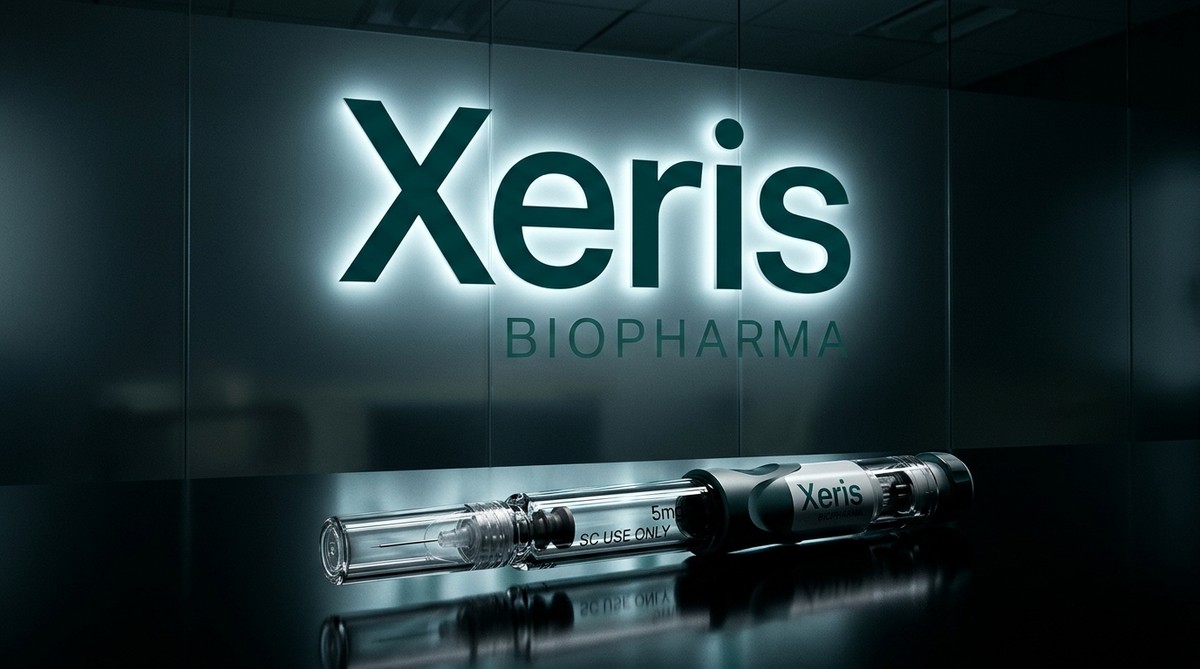
Xeris Biopharma: A Company That Just Turned Profitable Is Being Priced Like One That Always Was

Moe Alsumidaie by Moe Alsumidaie
November 4, 2026
in Research Notes
0
75
SHARES
1.2k
VIEWS
Share on XShare on LinkedInShare on Facebook

Four years ago, Xeris Biopharma was losing more than two dollars for every dollar it brought in. Today, the 10-K for fiscal year 2025 shows the company crossed into the black for the first time. That is not a rounding error. It is the end of a long, expensive climb, and the market has noticed: the stock has gained sharply over the past six months, our data show. The question worth sitting with is whether the price now reflects the climb already completed, or the one still ahead.

The story, briefly

Xeris spent years burning cash to build a commercial base; the filed numbers show it finally stopped losing money in 2025. The stock has repriced sharply to match that milestone. But the price-to-sales ratio, our data show, sits near the 87th percentile of the company’s own history, meaning the market is paying a premium it has rarely paid before. The open question is whether the next leg of growth, anchored to a pipeline drug that won’t read out until late 2028, justifies a valuation built for a company that has already arrived.

How it got here

Xeris built its commercial foundation on two emergency glucagon products: Gvoke, a ready-to-use liquid injection for severe low blood sugar, and Ogluo, an autoinjector version sold in Europe. In the early years, the company was still tiny, with losses that dwarfed its sales. Then it acquired Recorlev, a treatment for Cushing’s syndrome, a rare hormonal disorder, and revenue roughly doubled in a single year. By the full-year 2025 filing, revenue had reached $292 million, growing 44% in a year, and the net loss had shrunk to essentially nothing.

That trajectory matters because it was not accidental. The company layered products onto a shared commercial infrastructure, spreading fixed costs across a growing revenue base until the math finally worked. A business that once needed more than a dollar of spending to generate a dollar of sales now keeps a thin sliver of each dollar as profit. Thin is not the same as fragile, but it is not a cushion either.

BullScope TerminalWant the full evidence sheet behind pieces like this?The terminal runs the complete workup: XERS and 500+ other names, on the same official data.See the evidence engine →

What the most recent quarter shows

The latest filed quarter, ended June 30, 2026, reported in the Q2 2026 10-Q, shows net product revenue up 34% from a year earlier, crossing $91 million for the quarter. That is a strong number. The complication sits inside it: Gvoke, the product that started this company’s commercial story, posted a modest year-over-year decline in the same period, per the Q2 2026 earnings release. One flagship product slipping while the total grows means Recorlev is carrying more of the load. That concentration is worth watching.

The Q2 2026 earnings release shows management tightened its full-year 2026 revenue guidance to a range implying roughly a third more revenue than 2025. If it holds, that would be the company’s second consecutive year of accelerating growth after years of deceleration. Q3 2026 results are scheduled for November 5, 2026; that filing will be the next material update to the revenue trajectory described here.

The bet behind the valuation

The governance news from November 2, 2026, a board expansion 8-K, is not the story. Adding a director and granting a routine equity award is housekeeping. The real story is what the board is being asked to oversee.

Xeris’s pipeline centers on XP-8121, a once-weekly injectable form of levothyroxine, the standard thyroid hormone replacement taken daily by tens of millions of people worldwide. The pitch is simple: same drug, one shot a week instead of a pill every morning. The company’s pivotal “Cornerstone” trial is expected to start by the end of 2026, per the company’s pipeline update, with top-line results not expected until late 2028 and a potential launch around 2030. Management has cited a peak revenue opportunity in the billions for XP-8121, though that range spans an enormous amount of uncertainty and the trial has not yet started.

That four-year runway to a data readout is the central fact in any assessment of whether the current valuation is justified by the pipeline. The current valuation, our data show, puts the price-to-sales ratio at nearly 7 times, against a historical median closer to 4.5 times. The market is paying, in other words, for a story that includes XP-8121 succeeding. Phase 3 trials in this space do not always oblige.

Reading the numbers

  • Net margin, FY2025: 0.2%. What it is: the share of each revenue dollar left after all costs. What it means here: Xeris crossed from loss-making to profitable for the first time, but just barely. In everyday terms, a shop that takes in $1,000 and keeps $2 is profitable, but one bad month erases it. Filed in the FY2025 10-K.
  • Revenue growth, FY2025: 44%. What it is: how much faster sales grew than the prior year. What it means here: Xeris grew roughly ten times faster than the broader U.S. economy last year. A business growing that fast is either taking share, adding products, or both. Filed in the FY2025 10-K.
  • Q2 2026 net product revenue: $91 million, up 34%. What it is: sales of approved drugs in a single quarter. What it means here: annualized, this quarter alone would nearly match all of FY2023. Filed in the Q2 2026 10-Q.
  • Price-to-sales ratio: 6.7 times, 87th percentile of own history. What it is: the price tag per dollar of annual sales, a multiple (the amount investors pay per dollar of revenue). What it means here: a family paying $6.70 for every $1 of groceries in the basket, when they normally pay $4.50. Our data, computed from SEC filings and market prices.

Sources

  • 10-Q, quarter ended June 30, 2026
  • 10-K, fiscal year ended December 31, 2025
  • 8-K filed November 2, 2026, via Stock Titan
  • Xeris Q2 2026 earnings release
  • Xeris pipeline update, XP-8121
BullScope publishes impersonal research for a general audience. Nothing here is personalized investment advice, and nothing here is a recommendation to buy or sell any security. As of publication, neither BullScope nor its operator holds a position in any security, covered or otherwise; we do not trade at all, and we accept no compensation from any company we cover. When a conflict of interest exists, we do not publish: companies that compensate our operator in any capacity, or about which our operator could hold nonpublic information, are barred from coverage automatically, as described in the conflicts policy in our methodology. Figures come from company filings and public data through our published methodology; forecasts are conditional scenarios, not predictions and not promises. Markets carry risk, including loss of principal. Consider your own situation, or consult a licensed adviser, before acting on anything you read.
BullScope TerminalYou just read XERS’s filed numbers.Every claim above traces to a filing. Run any of 500+ companies through the same math-vs-mood engine. Free tier available.Open the Terminal →
Moe Alsumidaie

Moe Alsumidaie

Moe Alsumidaie, MBA, MSF, is founder and Chief Editor of Vanguard Publications, which publishes Clinical Trial Vanguard, Pharma Vanguard and BullScope, and Head of Research at CliniBiz. He has two decades in clinical trial operations and data science, with earlier roles at Genentech, Abbott Vascular and Stanford University Medical Center, and is a guest lecturer in clinical trial sciences at Rutgers University.

Recommended For You

Ligand Pharmaceuticals: Royalties Are Surging. The Stock Price Assumes They Never Stop.

by Moe Alsumidaie
November 6, 2026
0

Ligand spent most of the last decade shedding things. It spun off its antibody discovery unit in November 2022, sold assets, and narrowed toward a single idea: own...

Read moreDetails

Harrow: Revenue Doubles, Equity Nearly Vanishes, and the Stock Is Down by Half

by Moe Alsumidaie
November 5, 2026
0

The quick read Harrow's filed numbers show revenue growing at a pace most pharmaceutical companies never see, more than fivefold in five years. The 10-Q filed for the...

Read moreDetails

Adaptive Biotechnologies: The Company That Lost Money for Years Just Turned a Quarterly Profit, and the Stock Is Priced Like It Already Won

by Moe Alsumidaie
November 5, 2026
0

In one breath Adaptive Biotechnologies spent six straight years burning more cash than it earned, losing more than a dollar for every dollar of revenue as recently as...

Read moreDetails

Vericel: The Company That Finally Started Making Money Is Priced Like It Stopped

by Moe Alsumidaie
November 4, 2026
0

For most of its public life, Vericel lost money while growing fast. It sells two unusual things: living skin grafts for severe burn patients, and cartilage repair implants...

Read moreDetails

Regeneron’s Filing Shows a Business Earning More and a Pipeline Delivering More, While the Stock Trades as if Neither Is Happening

by Moe Alsumidaie
November 3, 2026
0

Regeneron spent most of the 2010s as a one-drug story. Dupixent, its blockbuster treatment for eczema and asthma, carried the company's reputation and most of its revenue. Then...

Read moreDetails
Next Post

Amgen's revenue growth slows to 8% as biosimilar competition erodes legacy franchises

Please login to join discussion
BullScope
The Research Terminal
Run any stock through the BullScope evidence engine. Filings in, evidence out. Every number explains itself.
Open the Terminal
A BullScope product

Related News

USANA: The Cash Is Real, the Loss Is Not, and the Customer Count Is the Story

September 18, 2026

Evidence Sheet: General Electric (GE)

October 22, 2026

Mirum Pharmaceuticals: A Pipeline on Fire, a Price That Went Cold

October 12, 2026
BullScope

BullScope is an evidence-first investment research publication. Every note starts in the filings: what companies actually report, what the market assumes, and where the two disagree. We read the numbers so you can read the story. Not investment advice.

Prefer BullScope.ai on Google

© 2026 BullScope. Evidence-first investment research. Not investment advice.  ·  Methodology  ·  Privacy Policy  ·  Terms of Use  ·  Disclaimer

No Result
View All Result
  • Home
  • Market News
  • Bargains & Bubbles
  • Expectations Audits
  • Research Notes
  • Said vs. Filed
  • The Economy
  • Evidence Sheets
  • Research Terminal

© 2026 BullScope. Evidence-first investment research. Not investment advice.  ·  Methodology  ·  Privacy Policy  ·  Terms of Use  ·  Disclaimer

Not enough quota to unlock this post
Unlock left : 0
Are you sure want to cancel subscription?
We use cookies to ensure that we give you the best experience on our website. If you continue to use this site we will assume that you are happy with it.