The story, briefly
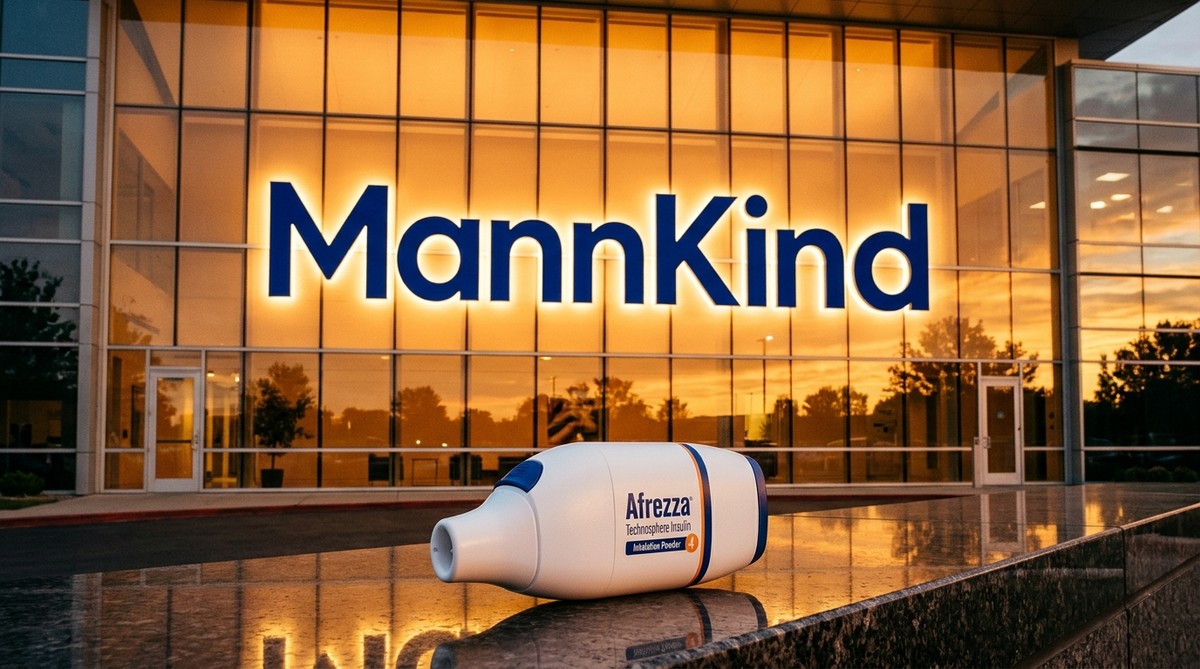
MannKind spent a decade burning cash on inhaled insulin that almost no one prescribed. The filed numbers now show a real business: revenue has grown roughly fivefold since 2020, and the company posted its first profitable year in 2024. But the most recent quarter shows a net loss again, the debt pile is roughly equal to a full year of revenue, and the stock has fallen almost in half from its 52-week high. The math and the mood are pulling in opposite directions, and the open question is whether the new products can compound fast enough to close the gap before the balance sheet demands attention.
A decade of almost, then a turn
MannKind’s inhaled insulin, Afrezza, won FDA approval in June 2014, and for years the company’s story was a cautionary tale about a product that worked in the lab but couldn’t find its way into doctors’ offices. Revenue sat in the mid-double-digit millions, losses piled up, and the balance sheet looked like a slow emergency. What changed the trajectory wasn’t Afrezza alone. A 2018 partnership with United Therapeutics to commercialize Tyvaso DPI, an inhaled treatment for pulmonary hypertension, brought in royalties that grew quietly in the background. By 2023, those royalties helped push total revenue to $199 million, nearly double the prior year. Then in October 2025, MannKind acquired scPharmaceuticals, adding Furoscix, an injectable diuretic for heart failure patients, to the portfolio. That acquisition is the biggest structural change in the company’s history, and it’s still being digested.
For a saver trying to understand what MannKind sells today: think of it as three revenue streams in one company. Afrezza generates direct product sales. Tyvaso DPI generates royalties paid by United Therapeutics. And Furoscix, the newest addition, generates its own product sales while also carrying the costs of a freshly integrated commercial operation. That diversification is new, and it cuts both ways.
What the latest filing actually shows
The 10-Q for the quarter ended June 30, 2026, filed August 5, 2026, is the most recent filed period. Total revenues reached $109.4 million for the quarter, a strong increase over the same quarter a year earlier, driven by the Furoscix addition and growing collaboration revenues. Afrezza contributed $17.0 million in net sales, helped by the FDA’s May 2026 approval expanding its use to children aged six and older, the first inhaled mealtime insulin cleared for pediatric patients. Furoscix added $22.2 million in net sales, roughly 30% more than Afrezza. The rest came from royalties and licensing agreements, including a milestone payment tied to the ralinepag DPI program.
Against that revenue, the company recorded a net loss for the quarter. The “math” here, what the filed fundamentals show, is a business whose top line is growing but whose cost structure expanded sharply when it absorbed scPharmaceuticals. Research and development spending ran to $35.2 million in the first half of 2026 alone, and selling and administrative costs have climbed with the expanded commercial team. The “mood,” what the market is currently pricing, is a stock sitting at $3.23, down sharply over the past year and nearly half off its 52-week high. Those two readings reflect a real tension: revenue is compounding, but profitability has slipped back after one year of positive earnings in 2024.
The debt is the weight in the room
As of June 30, 2026, MannKind held roughly $111 million in cash and short-term investments, a figure that sounds comfortable until it sits next to the term loan balance of $319.1 million. That debt is larger than the company’s entire annual revenue was just two years ago. A household analogy: imagine earning a decent salary and carrying a loan more than twice as large, while also funding a renovation and launching two new product lines simultaneously. The cash provides a runway, but not a long one if losses persist.
The company raised $50 million through a private placement closed July 24, 2026, almost entirely to fund a $45 million contingent value right payment triggered by the FDA’s approval of the Furoscix ReadyFlow autoinjector on July 23, 2026. That approval is genuinely meaningful, a device that makes Furoscix easier for patients to self-administer at home, but the financing required to honor the CVR commitment illustrates how tightly the capital structure is managed.
What’s compounding in the pipeline
MannKind’s pipeline is more active than at any point in its history. The nintedanib DPI program for idiopathic pulmonary fibrosis, a scarring lung disease with few good treatment options, reported positive Phase 1b safety results in July 2026, with a Phase 2 study now enrolling globally. An inhaled bumetanide program received FDA clearance to proceed later in 2026. And in September 2026, MannKind signed a licensing agreement with Rose Pharma to develop an inhaled GLP-1 for weight management, a category attracting enormous commercial interest. None of these programs generate revenue today, and the data cannot yet say which, if any, will reach patients. But the pipeline represents optionality that the filed financials do not yet capture.
Reading the numbers
- $109.4 million in Q2 2026 revenue. What it is: total sales, royalties, and licensing income for the quarter ended June 30, 2026. What it means here: the business is generating real, diversified income, not just one product’s fate. Everyday terms: if a small bakery sold bread, catered events, and licensed its recipes, this is the combined weekly register, not just the bread counter.
- $319.1 million term loan. What it is: the outstanding balance on MannKind’s primary debt facility as of June 30, 2026. What it means here: every dollar of profit earned first services this obligation before it can fund growth or reduce losses. Everyday terms: a family earning $80,000 a year with a $320,000 mortgage, except the mortgage comes due faster than a standard home loan.
- Net margin swings: 9.7% in FY2024, then 1.7% in FY2025, then a loss in Q2 2026. What it is: the share of each revenue dollar left after all costs, per our data computed from SEC filings. What it means here: profitability arrived, then retreated as the scPharmaceuticals acquisition added costs faster than revenues scaled. Everyday terms: a shop that cleared $10 on every $100 of sales one year, then $1.70 the next, then lost money, because it opened a second location mid-year.
Sources
- 10-Q for quarter ended June 30, 2026 (SEC EDGAR)
- MannKind Q2 2026 earnings release, August 5, 2026
- 10-K for fiscal year ended December 31, 2025 (SEC EDGAR)
- 10-K for fiscal year ended December 31, 2024 (SEC EDGAR)
- 10-K for fiscal year ended December 31, 2023 (SEC EDGAR)
- FDA approval of Afrezza, June 2014 (MannKind investor relations)
- FDA approval of Afrezza pediatric indication, May 2026