

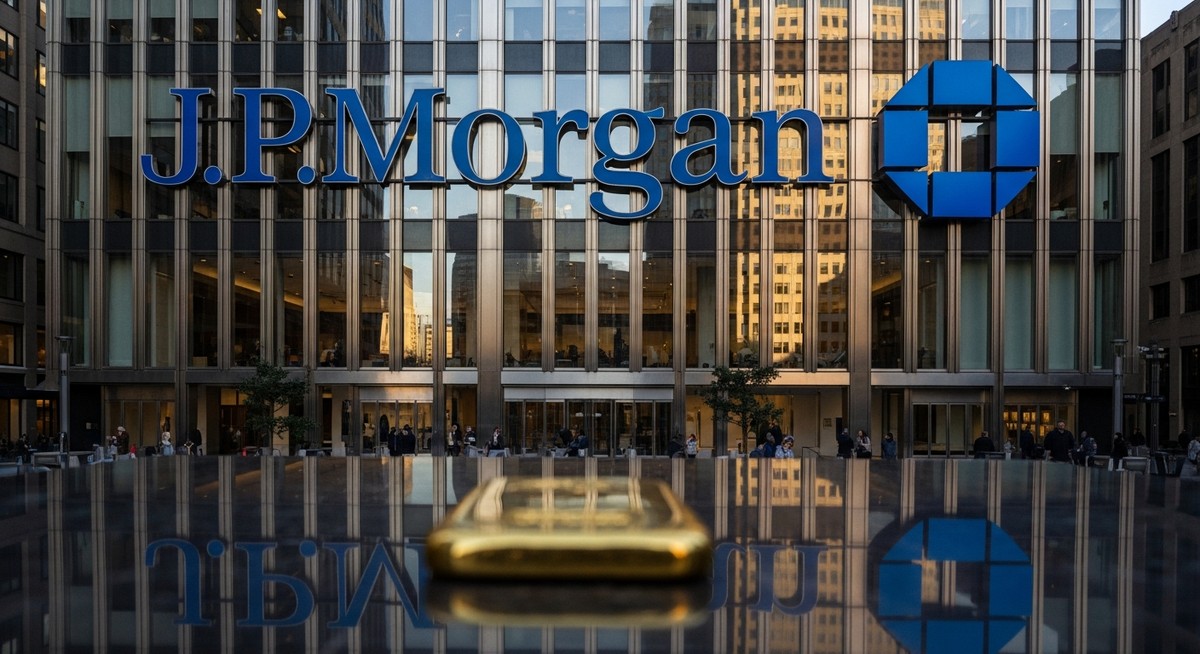
Six years ago, JPMorgan set aside billions against pandemic loan losses that never fully materialized, then spent the next four years riding the steepest interest-rate cycle in a generation. Revenue climbed from $119.5 billion in 2020 to $177.6 billion by 2024, according to our published methodology compiled from SEC filings. Growth has now slowed sharply, to under 3% in 2025. And yet the stock, at its 52-week high as of mid-July, sits at a valuation the market has never assigned it before. That tension is the whole story.
The immediate trigger is a single filed number: net income of $21.2 billion for the second quarter of 2026, announced July 14. That is the largest quarterly profit in the firm’s history, more than most S&P 500 companies earn in an entire year.
The math
The engine behind the record is interest income. JPMorgan reported net interest income of $25.6 billion in Q2 2026, up meaningfully from the same quarter a year earlier. Think of net interest income as the spread between what the bank earns on loans and what it pays depositors: when that gap widens, every dollar on the balance sheet works harder. The year-over-year gain here is roughly the size of a mid-cap bank’s entire annual revenue.
Total revenue for the quarter reached $58.0 billion, and investment banking and equities fees surged alongside the interest income gain. Put the quarterly earnings pace together and the annual run rate would comfortably exceed what the firm posted for all of 2025. The five-year earnings arc shows how much the rate environment has transformed this business.
Credit quality, the number that tells you whether the good times are borrowing from the future, looks contained for now. The July 14 earnings release showed total net charge-offs of $2.4 billion and a provision for credit losses slightly above that, which includes a small reserve build concentrated in wholesale (commercial) loans. Management noted delinquencies came in slightly better than anticipated. The Q1 2026 10-Q, the most recent filing with full segment detail, showed the credit card charge-off rate at 3.46% as of March 31, with consumer and commercial loans well below 1%. Full-year card charge-off guidance implies modest improvement from that Q1 rate. For now, the losses are real but not alarming.
The mood
The market is paying a price-to-earnings multiple of 15.8 times, against a decade median of 12.1 times for this same stock, per our published methodology. That puts JPMorgan at the 100th percentile of its own valuation history: every other reading in the past ten years was cheaper. The price-to-sales ratio tells the same story, sitting well above its decade median. If the median multiple is what a patient buyer has historically paid for this business through full cycles, the current price embeds a meaningful premium above that baseline.
The mood has a logic to it. A record profit quarter, a raised full-year net interest income outlook of approximately $105.5 billion, and a Fed stress test in June that confirmed all 32 large banks remain well-capitalized through a severe hypothetical scenario: these are the ingredients of investor confidence. The stock’s strong gain over the past twelve months reflects a market that believes the good quarter is a floor, not a ceiling.
The gap
Here is where math and mood diverge. “The math” is what the filed fundamentals justify on their own terms. “The mood” is what investors are currently willing to pay. Right now the mood is running well ahead of the math’s historical anchor.
The bull reading is straightforward: revenue growth has compounded at a pace that justifies a premium multiple, the credit book is holding, and management just raised its own guidance. If the interest income trajectory continues and charge-offs stay near current levels, the earnings power that produced this record quarter could persist long enough to grow into today’s valuation.
The bear reading starts with the same filed numbers. Revenue growth decelerated sharply from 2023 through 2025, per our data. A single blowout quarter does not reverse that trend. Management’s own commentary on the earnings call flagged mild deterioration in certain market credit underwriting standards and described the environment as a late credit cycle. The wholesale reserve build, small as it is, points in the same direction. BLS data through June 2026 shows the unemployment rate still elevated relative to post-pandemic lows. Fitch’s U.S. leveraged loan default rate reached 4.5% in May 2026. None of these readings are crisis signals, but they are not early-cycle signals either. A bank priced at a century-high multiple has little room for the credit cycle to turn.
The honest answer is that the gap between a 15.8 times multiple and a 12.1 times historical median is not explained by the filed numbers alone. It requires the credit cycle to stay benign, the interest income tailwind to persist, and expenses to stay in line with management’s full-year guidance. All three conditions must hold simultaneously.
What changes the read
The Q2 2026 10-Q, expected to be filed several weeks after the July 14 earnings release, will provide the full allowance for credit losses as of June 30 and segment-level delinquency data that the preliminary earnings announcement did not include. Those figures will either confirm or complicate the “better than expected” credit narrative. The next quarterly earnings release, covering Q3 2026, will arrive in mid-October and will show whether the raised net interest income guidance was conservative or optimistic. If charge-offs in the card book drift above the full-year guidance, or if the wholesale reserve build accelerates, the math supporting a premium multiple becomes harder to defend. If credit holds and interest income lands near the raised target, the mood may simply have been right earlier than the median suggested.
Reading the numbers
Net income of $21.2 billion (Q2 2026). Net income is what remains after every expense, tax, and credit loss is paid. For context, $21.2 billion in a single quarter is more than most large American companies earn in a full year. It matters here because it sets the record that the current stock price is partly paying for, and because sustaining it requires the same favorable conditions, high interest rates, calm credit, strong markets, to persist.
P/E ratio of 15.8 times, against a decade median of 12.1 times. The price-to-earnings ratio (P/E) is simply the stock price divided by annual earnings per share: it tells you how many dollars the market pays for each dollar of profit. A P/E of 15.8 versus a median of 12.1 means investors are paying about 30% more per dollar of earnings than they have on average over the past decade. If you paid $120 for something that historically cost $100, you need the thing to keep getting better just to break even on the premium.
Net charge-off rate of 3.46% on credit cards (Q1 2026 10-Q, as of March 31). A charge-off happens when the bank concludes a borrower will not repay and writes the loan off as a loss. A 3.46% annual rate means that out of every $100 the bank has lent on credit cards, it expects to lose about $3.46 that year. That is not a crisis number, but it is meaningfully higher than the near-zero rates seen in 2021. It matters because credit cards are one of the bank’s highest-margin businesses, and rising losses there eat directly into the profits driving today’s record quarter.
For the standing yardsticks on JPMorgan Chase &: the price tag, the filed record, and the four gauges, refreshed with each edition, see the BullScope Evidence Sheet: JPMorgan Chase &.
Sources
- JPMorgan Chase Q2 2026 earnings release, July 14, 2026
- JPMorgan Chase Q1 2026 10-Q filing
- GuruFocus: JPM Q2 2026 earnings call highlights
- GuruFocus: JPM Q2 2026 stock reaction
- Investing.com: JPM Q2 2026 earnings call highlights
- Investing.com: JPM Q2 2026 earnings call transcript
- Seeking Alpha: JPM Q2 2026 earnings beat
- Investing.com: JPM Q2 2026 investor presentation
- Bank Policy Institute: 2026 Fed stress test results
- Bureau of Labor Statistics: U.S. unemployment and payroll data through June 2026