

In one breath
Organogenesis built a $564 million business selling advanced wound-care products to Medicare patients, then watched a single CMS reimbursement change in late December 2025 cut that revenue roughly in half inside two quarters. The stock, already down nearly seventy percent over the past year, is priced at less than a third of one year’s sales, a level our data has never recorded for this company. The open question is whether the clinical pipeline and a leaner cost structure can rebuild the business before the cash runs out.
What this company was, and what happened to it
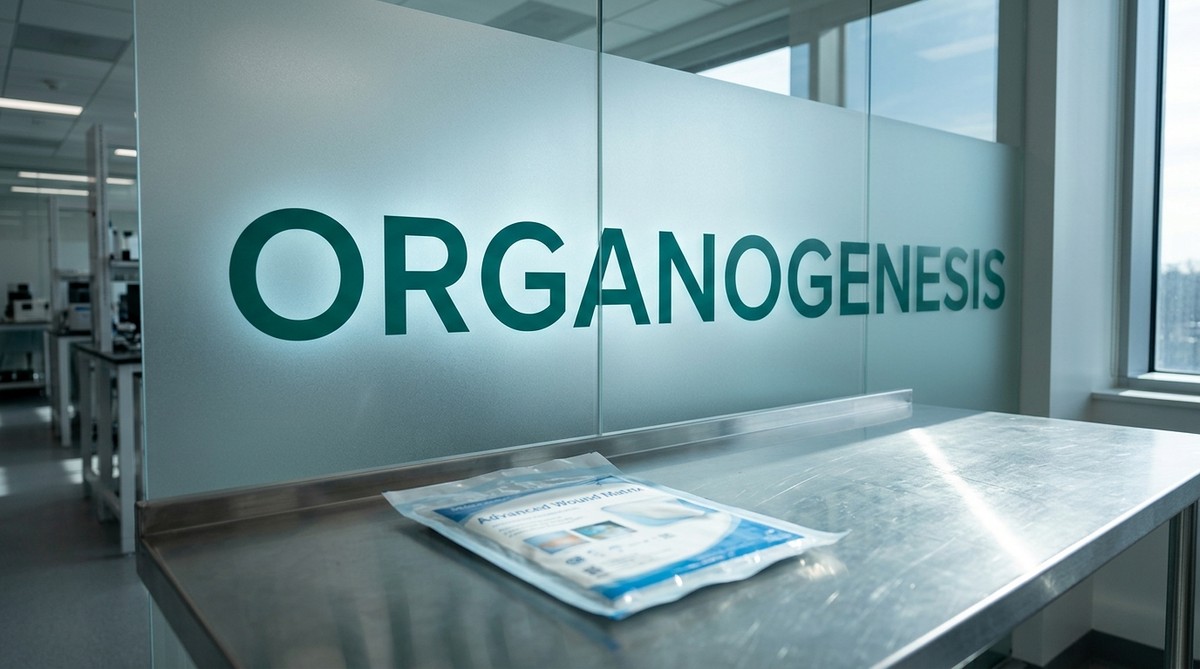
Organogenesis makes living tissue products: sheets of engineered skin and wound coverings that help diabetic ulcers and surgical wounds close when ordinary bandages cannot. For most of its life the business ran on Medicare reimbursement, meaning the federal government was effectively the customer for the majority of its revenue. That arrangement made the company’s fortunes unusually sensitive to one payer’s pricing decisions.
The good years were very good. Revenue for fiscal year 2025 reached $564 million, up from the year before, and the company posted its best net margin since 2021. Then, in late December 2025, the Centers for Medicare and Medicaid Services withdrew the Local Coverage Determinations that had supported reimbursement for skin substitutes and revised its fee schedules. A Local Coverage Determination is essentially Medicare’s written permission slip for a treatment; without one, clinicians stop ordering the product almost immediately.
The effect was immediate. Clinics that had been buying Organogenesis products every week stopped ordering. The company’s largest segment, Advanced Wound Care, saw revenue fall by nearly two-thirds in the first half of 2026 compared to the same period a year earlier.
What the quarter actually shows
The 10-Q filed August 6, 2026, for the quarter ended June 30, 2026, puts the damage in plain numbers. Net product revenue for the second quarter came in at $42.8 million, against $100.8 million in the same quarter of 2025. That is not a slowdown; it is a business operating at less than half its prior run-rate.
What makes the quarter harder to read is the margin collapse alongside the revenue drop. Gross margin, the share of each sales dollar left after making the product, fell by roughly half compared to the same period a year earlier. Think of a bakery that used to keep nearly three-quarters of every dollar after flour and labor; it now keeps barely more than a third, while baking far fewer loaves. Fixed manufacturing costs spread over a much smaller revenue base is the mechanical reason, but the Dermagraft relaunch delay compounds it: the company disclosed an indefinite postponement of that product’s return to market, citing regulatory uncertainty, which removes a planned source of volume recovery.
The net loss for the first half of 2026 was larger than the company’s entire projected revenue for the second half of the year at the midpoint of guidance, a household analogy being a family that spends more in six months than it earns in the following six.
What is being cut, and what is being kept
Management launched two restructuring rounds, in March and June 2026, targeting more than $32 million in annual operating expense savings through workforce reductions and facility closures. Real cost is being removed, roughly equivalent to what the company once earned in a good quarter.
What is conspicuously not being cut is research and development. R&D spending rose sharply in the second quarter of 2026 compared to a year earlier. That is a deliberate choice, and it points toward the one asset management is protecting: the clinical pipeline.
In July 2026, the FDA accepted a Biologics License Application for ReNu, a cell therapy for knee osteoarthritis, setting a target review date of April 24, 2027. Separately, the company published positive randomized controlled trial results for PuraPly AM in diabetic foot ulcers in April 2026, and for Affinity in complex venous leg ulcers in July 2026. Randomized controlled trial data is the strongest clinical evidence class, and it matters here because CMS coverage decisions increasingly require it. Building that evidence base is how Organogenesis argues for reimbursement reinstatement.
The math and the mood
“The math” is what filed fundamentals justify; “the mood” is what the market is currently paying. Right now, the mood is severe. The stock trades near historic lows relative to sales, at a price-to-sales ratio our data has never recorded for this company, the decade median sits roughly three times higher. A business priced this far below annual revenue sits at a level where the filed numbers present two unresolved scenarios: one in which the revenue impairment is structural and the current price reflects that reality, and one in which reimbursement partially recovers and the same price reflects a different arithmetic. The filing does not yet distinguish between them.
What the math does show: the company reported positive free cash flow for the twelve months ending June 30, 2026, per MarketBeat’s analyst summary. That is a narrow but real buffer. The consensus analyst view, as reported by TipRanks, sits at “Hold” to “Reduce,” with price targets that, at the time of this writing, cluster near current trading levels. Readers can weigh what conditions would need to hold for that consensus to shift in either direction.
The tension that cannot be resolved from the filing alone is whether the CMS policy reversal is permanent or correctable. If the clinical trial data for PuraPly AM and Affinity supports new coverage determinations, the revenue base could partially rebuild. If the reimbursement environment stays as it is, the restructured cost base must sustain a business running at well under half its 2025 revenue. The filing describes both possibilities honestly. It does not resolve them.
Reading the numbers
- $42.8 million Q2 2026 net product revenue (filed in the 10-Q for the quarter ended June 30, 2026). What it is: total sales of products in the quarter. What it means here: this is 42% of the $100.8 million the company recorded in the same quarter a year earlier. In everyday terms, imagine a restaurant that served 100 tables a night last summer serving 42 tables this summer, with the same kitchen overhead.
- 37% gross margin, first half 2026 (same filing). What it is: of every dollar of product revenue, 37 cents remained after manufacturing costs. What it means here: a year ago the same figure was 73 cents. The drop reflects fixed factory costs spread over far fewer units sold, plus the Dermagraft delay removing a planned volume contributor.
- $149.4 million net loss, first half 2026 (same filing). What it is: the total loss after all costs, including restructuring charges. What it means here: this sum is larger than the company’s entire projected revenue for the second half of 2026 at the midpoint of guidance. A household analogy: spending more in six months than the whole family earns in the following six.
- $32 million annualized expense reduction target (per the Q2 2026 earnings release). What it is: the projected annual savings from the two restructuring rounds. What it means here: at the low end of 2026 revenue guidance, $32 million represents roughly 18% of the year’s expected sales, a meaningful reduction but not enough on its own to return the company to the margins it posted in 2025.
Sources
- 10-Q for quarter ended June 30, 2026 (SEC EDGAR)
- 10-K for fiscal year ended December 31, 2025 (SEC EDGAR)
- 10-K for fiscal year ended December 31, 2024 (SEC EDGAR)
- Q2 2026 earnings release (StockTitan)
- FDA event history, MarketBeat
- Analyst consensus and price targets, MarketBeat
- Analyst forecast summary, TipRanks
- Q2 2026 earnings call transcript (The Motley Fool)
- Clinical trial commentary, Seeking Alpha
- PuraPly AM and Affinity trial results (StockTitan)